
Finding New Donors for Your Nonprofit: A How-to Guide
It’s no secret that periodically finding new donors is essential for your nonprofit to expand its fundraising capabilities and therefore bring in more revenue to fund its mission. However, donor identification and acquisition generally require significant time, resources, and effort from your team, which can leave you wondering whether the results are worth the work you put in.
Although the answer to this question is typically yes, the benefits will be clearer to you if your nonprofit develops and executes an acquisition strategy that makes the process both more efficient and more effective. In this guide, you’ll learn everything you need to know about finding new donors for your organization, including:
- Finding New Donors FAQ
- How to Find New Donors: Top Strategies
- How DonorSearch Helps With Finding New Donors
By following the tips in this guide, you’ll be able to quickly secure gifts from qualified new donors and set up the potential for long-term relationships between them and your nonprofit. Let’s get started!

Finding New Donors: Frequently Asked Questions
How do I find new donors for my nonprofit?
Your nonprofit’s approach to finding new donors will depend primarily on what size gifts you want to secure. To attract small-dollar donors to your organization, cast a wide net by creating an optimized website and using mass marketing channels like social media, digital ads, and flyers to spread the word about your mission. Converting these donors is usually fairly straightforward—just make it easy for them to find resources about your cause and take the next step of giving, and be available to answer questions that may come up along the way.
Mid-level donors might also find your organization through mass marketing, but some more targeted outreach via referrals and personalized emails or direct mail may help encourage them to give. Major donors require the most involved and personalized identification processes—research, comprehensive screening, and individualized contact leading into a cultivation process that often takes several months before solicitation can occur.
How do I know that I’ve found a new potential major donor?
For a donor to be a viable major giving prospect, they need to be able and willing to make a significant contribution to your specific nonprofit. After all, just because an individual is wealthy doesn’t mean they have charitable tendencies, and even a wealthy individual who has generally been philanthropic may not care enough about your organization or cause to give you a major gift.
To ensure potential donors have all of the characteristics of a major giving candidate, look for the following three types of information when researching them, which are also known as markers or indicators:
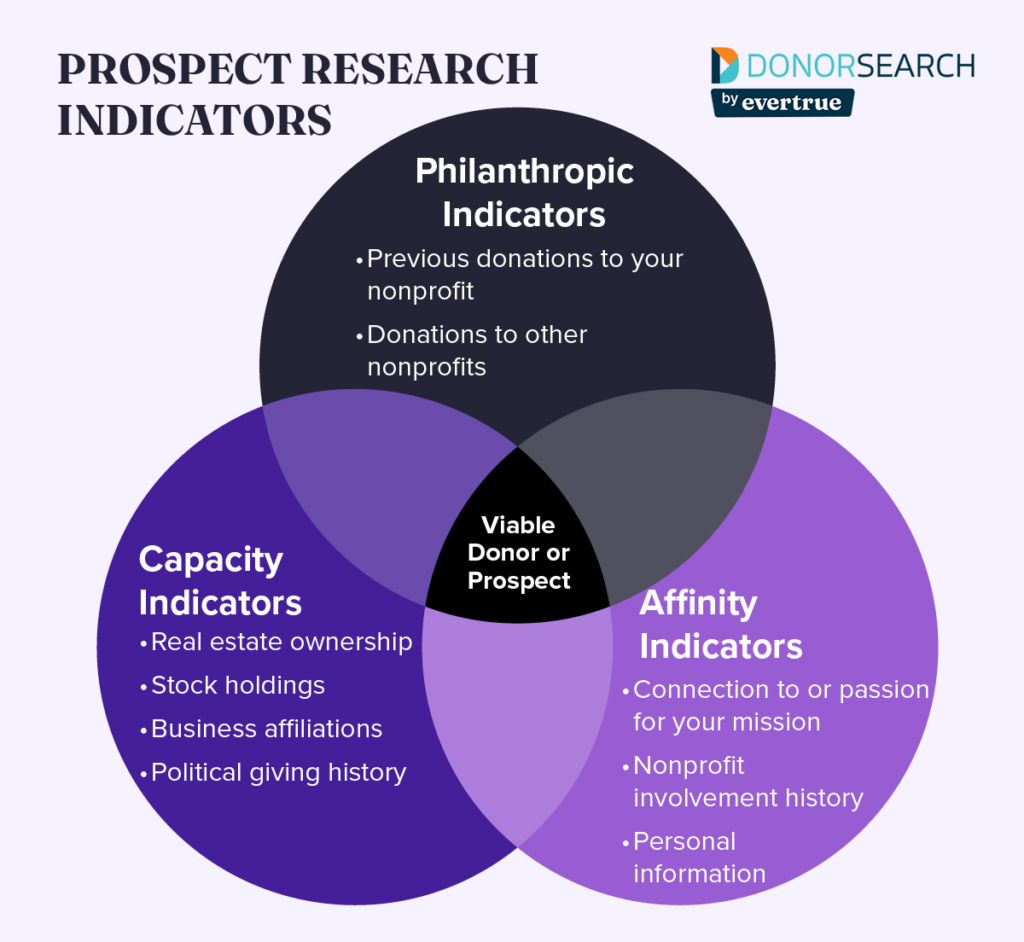
- Capacity (wealth) indicators: Real estate ownership, stock holdings, business affiliations, and political giving history
- Philanthropic (general charitable tendency) indicators: Past donations to your organization and to other nonprofits
- Affinity (organizational warmth) indicators: A connection to or passion for your mission, a history of non-donation nonprofit involvement (event attendance, volunteering, board service, etc.), and relevant personal details like interests and values
A viable prospective major donor will exhibit at least some indicators in all three categories, and the stronger those indicators are, the higher that prospect should be on your outreach list.
Which is more important: Finding new donors or maintaining relationships with existing supporters?
It depends on your nonprofit’s situation and goals. The most important times to prioritize finding new donors include:
- When your organization is starting out so you can secure the support you need to get up and running.
- As you plan a capital campaign or other major initiative, since expanding your fundraising capacity will help you reach more ambitious goals.
- After your nonprofit experiences significant supporter churn to rebuild your donor base and push forward through that challenge.
However, identifying new donors is significantly more expensive than retaining existing ones—on average, nonprofits spend $1.50 per dollar raised on donor acquisition, but only $0.20 per dollar raised on donor retention. So, maintaining relationships with current supporters should be your top priority day-to-day, and especially during times of financial hardship.
What metrics should my nonprofit track when finding new donors?
The most important fundraising metrics associated with new donor acquisition include:
- Donor acquisition rate: Of your nonprofit’s donors this year, how many gave for the first time?
- Donor growth rate: By how much is your donor base expanding year to year, given acquisition and churn combined?
- Conversion rate: How many donors who were given the opportunity to make a first gift actually did so (and which outreach methods yielded the most and least conversions)?
- Donor acquisition cost: How much is your nonprofit spending on average to secure a new donor’s support?
Donor acquisition cost data is particularly useful for shaping your strategy over time, since you can compare your spending on finding new donors across channels, campaigns, or time periods and adjust your approach accordingly. If you’re ready to determine this metric for your nonprofit, you can use the calculator below to get started!
Acquisition Cost
Measure your fundraising efficiency
Cost Per New Donor
Total Acquisition Spend ÷ New Donors Acquired
Pro-Tip: To see your true ROI, ensure your Donor Lifetime Value (DLV) is significantly higher than this Acquisition Cost.
How to Find New Donors: Top Strategies
Now that we’ve established a foundation to help your nonprofit identify new donors, let’s dive into more specific ways to do so practically!
Set Goals for Donor Acquisition
As with nearly any initiative at your nonprofit, an effective approach to finding new donors begins with a clear goal. Using the SMART framework will make your goals more actionable because they’ll be:
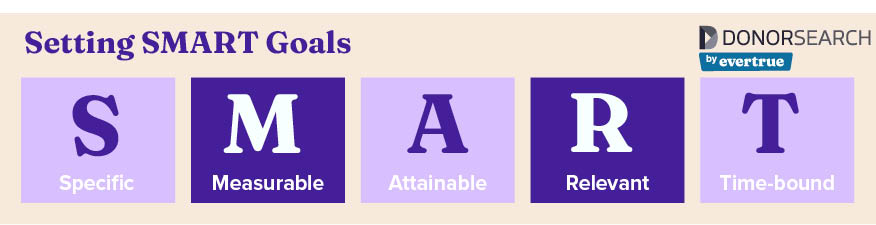
- Specific about what you hope to accomplish and to an initiative or campaign
- Measurable to provide clear benchmarks to aim for as you track key metrics
- Attainable so they push your team without being so far out of reach that they’re demotivating
- Relevant to your nonprofit’s overarching priorities and primary reason for finding new donors
- Time-bound so you have a clear deadline by which you should reach your target.
For example, your organization might set a goal “to secure gifts to our current capital campaign from 10 new major donors by the planned end of the quiet phase one year from now.” This goal has an acquisition rate target and deadline attached, specifies the types of donors you want to find and your reason for securing their support, and is relevant to your nonprofit’s priority of conducting a capital campaign.
To determine if your goal is attainable, look back at any available data from your last capital campaign. If you know you received major gifts from eight brand-new donors last time around, 10 is probably within reach for your team—it’ll be a challenge, but likely a welcome one.
Expand Your Organization’s Web Presence
Your nonprofit’s website is its digital information hub and an essential tool for collecting contributions, so it should be a central element of your efforts to attract new donors. While on-site practices like building out thorough content, ensuring mobile responsiveness, and balancing aesthetics with accessibility in design are important for converting visitors, these measures will only benefit your organization if new donors can easily find your site.
Here are a few ways to increase your website’s visitor numbers:
- Link to your website in all other marketing materials. Your site should be clearly featured in your organization’s social media profiles, digital ads should direct traffic to it, and calls to action in emails and text messages should lead to your donation page or other relevant website forms. Even print materials like flyers and direct mail messages can include easy-to-type links or QR codes that encourage audiences to visit your website for more information or to donate.
- Optimize for search engines. In addition to advertising on Google, your nonprofit can drive traffic to its site through organic search results by prioritizing search engine optimization (SEO). Mobile-friendliness and accessibility are key factors in SEO, along with targeting specific search terms (or keywords) in website content, refining your site’s metadata, and establishing your organization’s online authority by getting other reputable websites to link back to yours.
- Consider AI search visibility. Potential donors are increasingly learning information that’s relevant to their lives—including which nonprofits they may want to support—through Google’s AI search features and large language model platforms (LLMs) like ChatGPT and Gemini. To encourage these tools to cite your organization’s website, pay special attention to your site’s structured data, provide clear answers to common questions, and showcase proof of your mission impact throughout your webpages.
Once potential donors can find your website, they’ll have access to everything they need to give—clear call-to-action buttons directing them to a user-friendly donation form, a wealth of details about your cause to help them make an informed decision to click those buttons, and multiple ways to contact your organization with any questions.
Improve Your Social Media Strategy
Although social media can direct new supporters to your website, it also functions as a donation collection tool through initiatives like crowdfunding and post-based fundraisers. So, your nonprofit should think critically about its social media presence and make improvements by:
- Posting many different types of content, such as project updates, supporter spotlights, beneficiary testimonials, broad cause-related developments, and calls to get involved with your mission in multiple ways (both monetary and non-monetary).
- Tailoring posts to platform structures—for instance, you might share the same content as a text-based post on Facebook, a series of branded graphics on Instagram, a few short videos on TikTok, and a longer video on YouTube.
- Creating a content calendar to spread out your posting on each platform in a way that maximizes impressions but doesn’t overwhelm your followers (and using an AI tool to automate posting after making content in advance).
Unlike many mass marketing channels, social media encourages two-way communication. Take advantage of this interactivity by replying to relevant comments and direct messages, encouraging followers to share your posts, and incorporating user-generated content (i.e., where supporters post relevant content with specific hashtags and tag your organization so you can also share their posts) into your strategy.
Leverage Your Nonprofit’s Network
Your nonprofit doesn’t have to go about finding new donors alone! If your organization is well-established, you likely have a broad network of existing contacts, each with their own broad network of existing contacts. Tap into these vast potential donor bases by working with the following groups:
- Current supporters. In addition to sharing social media posts, your current supporters can introduce new donors to your nonprofit via peer-to-peer fundraising campaigns, referral programs, and even wearing or using your branded merchandise in public.
- Board members. Your board’s position as ambassadors of your organization in your community provides the perfect opportunity for making high-value introductions to prospective donors, especially since many nonprofit board members are well-connected.
- Corporate sponsors. Some businesses may run dedicated co-marketing campaigns with your nonprofit, while others might give you indirect access to their customer and employee bases by exchanging their fiscal support for your free publicity and allowing you to share links to their website or tag them on social media.
For donors who are on the fence about contributing to your nonprofit, a good word from an individual or organization they trust can be the seal of approval they need to trust and support you.
Consider the Full Donor Lifecycle
Identifying and reaching out to new supporters is just the first step in the donor lifecycle. Once you have a donor’s attention, you’ll need to build a relationship with them that leads to a donation request. After they respond positively to your solicitation, your next steps are to recognize their contribution, then keep them involved with your nonprofit until you ask them to give again, potentially at a higher level than before.
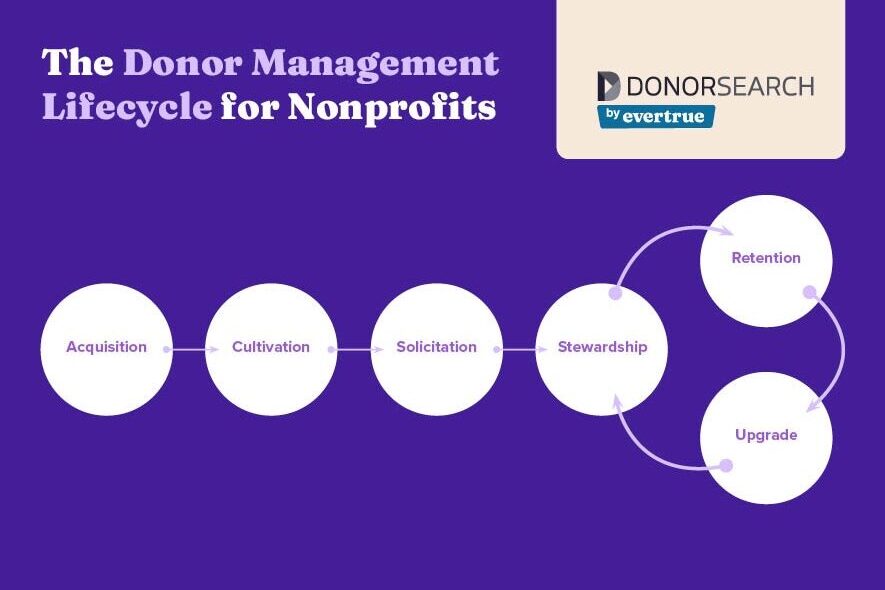
Keep this entire donor journey in mind when finding new supporters. For small-dollar donors, cultivation moves very quickly after acquisition and is often fairly hands-off, so focus on straightforward solicitations like adding colorful “Donate Now” buttons to your website and sharing links to campaigns directly in your social media feeds. Then, automate thank-you messages and welcome email series to kick off the stewardship-retention-upgrade cycle immediately after donors give.
For major donors, your next action after reaching out to a prospect will typically be a one-on-one meeting that begins the cultivation process. Then, you’ll use what you learn in that meeting to lay out a moves management plan that covers the entire donor journey (but can be adapted along the way if needed) and is tailored to that prospect. In any case, remember that your first impression on a donor can make or break whether you retain them long-term.
Conduct Comprehensive Prospect Research for Major Gift Fundraising
Prospect research is useful both for finding major donors within your existing supporter base and for identifying prospects who are brand-new to your organization. The process involves gathering a large amount of information not only on potential donors’ giving capacity, but also on their personal and charitable backgrounds (which is what distinguishes traditional wealth screening from comprehensive, contemporary prospecting) to pinpoint your best candidates for major giving.
The complete picture of a potential donor that thorough prospect research provides will direct your outreach efforts. Plus, if prospective donors don’t want to make a major monetary gift right away, you can determine if they’d be interested in other opportunities like setting up a planned gift, donating non-cash assets like stocks or cryptocurrency, or contributing to an endowment fund using the data you have collected on them.
Even though it’s estimated that 80% of nonprofits’ individual donation revenue comes from the top 20% of donors, your organization requires a diverse pool of donors and gift types to succeed. Making all giving paths known to new donors increases their likelihood of supporting you in the best way for them.
How DonorSearch Helps With Finding New Donors
If you’re in the market for a prospect research platform that also functions as a donor outreach engine, look no further than DonorSearch by EverTrue! More than 15,000 nonprofits of all sizes and missions trust our tools to help them find new donors for their most pressing initiatives. Our full suite of solutions includes:
- Access to the largest philanthropic database in the world, which consists of more than one billion data points from over 40 trusted, publicly available sources and is updated weekly.
- Wealth and philanthropic screening so you can get to know new and existing donors alike—and feel confident in your results, given that DonorSearch’s average accuracy rate is above 90%.
- Predictive modeling powered by DonorSearch Ai, the most advanced machine learning algorithm ever created for the nonprofit sector, to help you analyze prospecting data more deeply and prioritize outreach to your best candidates.
- Prospect report generation that uses our cutting-edge AI to condense the most important data points on each prospect into an actionable summary you can reference throughout cultivation and solicitation.
- More than 40 integrations with popular nonprofit CRMs and fundraising tools (including Salesforce, Bloomerang, multiple Blackbaud products, and our parent company EverTrue’s other solutions) to allow for seamless data transfer between platforms.
When it comes to finding new donors, especially those who will give significant amounts throughout their journeys with your organization, DonorSearch can save your nonprofit time and resources while driving better results. But don’t just take our word for it—check out this video to learn how Ronald McDonald House Charities of Chicagoland & Northwest Indiana leveraged DonorSearch to improve its acquisition and cultivation processes, which led them to secure multiple seven-figure contributions!
Final Thoughts
Although you won’t find all of the new donors your nonprofit is looking for in one place, you can make the process far easier on your team with a solid strategy. Focus on diversifying your approach, monitoring progress over time, and investing in the right tools (like DonorSearch for prospect research!), and the rest will fall into place.
For more information on how to find new donors and secure their support, check out these resources:
- How to Create a Donor Profile: Ultimate Nonprofit Guide. Explore a key resource for storing important details about all of your donors—new, existing, and prospective.
- Donor Analytics: How to Make the Most of Donor Data. Learn how to segment your existing supporters to pinpoint target audiences for various acquisition efforts.
- Nonprofit Analytics: How to Harness Data and Amplify Impact. Dive deeper into the metrics you can use to assess how donor identification and engagement is going.