
How to Create a Fundraising Gift Range Chart + Calculator
If you’re planning a capital campaign, preparing annual fund solicitations, or launching any other major fundraising initiative at your nonprofit, you may be wondering where to start looking for donations to get you to your goal. You need an effective strategy that empowers your team to extend the right fundraising asks at the right times to reach the best potential donors, backed by useful resources at every step of the way.
One essential tool for navigating large fundraising efforts is a gift range chart. In this guide, you’ll learn all you need to know about this resource, including:
- Gift Range Charts FAQ
- DonorSearch’s Gift Range Chart Template & Calculator
- Additional Tips for Using Your Gift Range Chart
A well-thought-out gift range chart can make all the difference in reaching your goals and successfully engaging supporters. Before we put this tool into action, let’s get started by ensuring we’re on the same page about what a gift range chart is and how it functions.
Gift Range Charts: Frequently Asked Questions
What is a gift range chart?
A gift range chart is a tool that provides a visual representation of the number and sizes of gifts you need to secure to achieve a fundraising goal. This tool breaks up major fundraising goals into manageable, individual gift amounts, so it tends to be most useful for large-scale initiatives like capital campaigns and annual fundraising.
Gift range charts typically take a pyramid-like, top-down approach, which is why they’re sometimes also called gift pyramids. You’ll list the largest donation amount at the top along with the number of gifts you need at that level, followed by lower-level gifts and their corresponding donation counts. The number of gifts at each level will increase as you move down the chart—you’ll typically need one gift at your top giving level, then two for the next level down and so on.
Here is an example of a gift range chart based on a total fundraising target of $1 million:
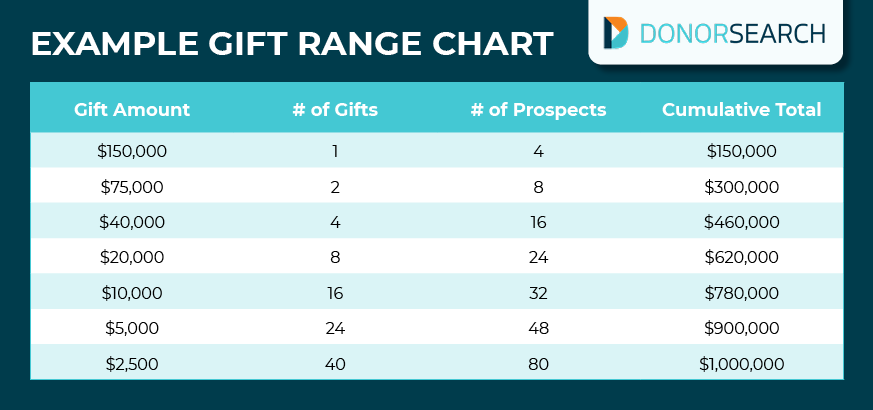
In addition to gift amounts and counts, it’s also helpful to include the number of potential donors you’ll need to identify who could give at each level. Your prospect count should always be two to four times higher than your number of gifts, leaning toward the upper end of that range for larger donation amounts and the lower end for smaller contributions. This way, you can ensure you get the gifts you need, even if some prospects don’t respond to outreach or don’t agree to give the amount you ask them for.
Why build gift range charts?
Despite their deceptively simple design, gift range charts tell you a lot about your fundraising strategy for major campaigns. Specifically, you can determine:
- Whether your fundraising goals are realistic. Gift range charts may show gaps in your strategy where you need to find new prospects (especially for large-scale campaigns, which won’t rely solely on existing donors). If there are sizable holes in your chart, that could be a sign that you need to adjust your goal.
- Which and how many prospects to target. Depending on how you approach fundraising and gift range chart creation, your chart may be limited to major gifts or also include mid-level and smaller contributions. When you see your chart laid out, you can more effectively decide whether your approach is working and, if so, how to go about cultivation.
- What giving levels to suggest to potential donors. Your supporters will only know what your fundraising goals are if you give them a target to follow. Compare your gift range chart with your potential donors’ wealth information to present requests that they’ll find reasonable but also don’t leave money on the table.
- How to prioritize your time and resources. Once you know how many prospects you need to target and how much to expect from these donors, you can invest in acquiring and cultivating individuals who could give the specific amounts you need without stretching your team’s bandwidth or your campaign budget too far.
- How you’ll track and report campaign progress. A gift range chart is a framework for taking a logical, strategic approach to securing gifts. It can help everyone, from your board to your major gift officers, see what it will take to achieve your fundraising goal. That way, your whole team can stay on track throughout the campaign.
Your gift range chart doesn’t simply lay out fundraising benchmarks—it influences your whole campaign strategy. Creating this resource can show you what it will take to achieve your fundraising goals and help you lay out the steps you should take to succeed.
How do I create a gift range chart for my nonprofit?
To start building a gift range chart, all you really need to know is your overall fundraising goal. From there, follow these basic steps:
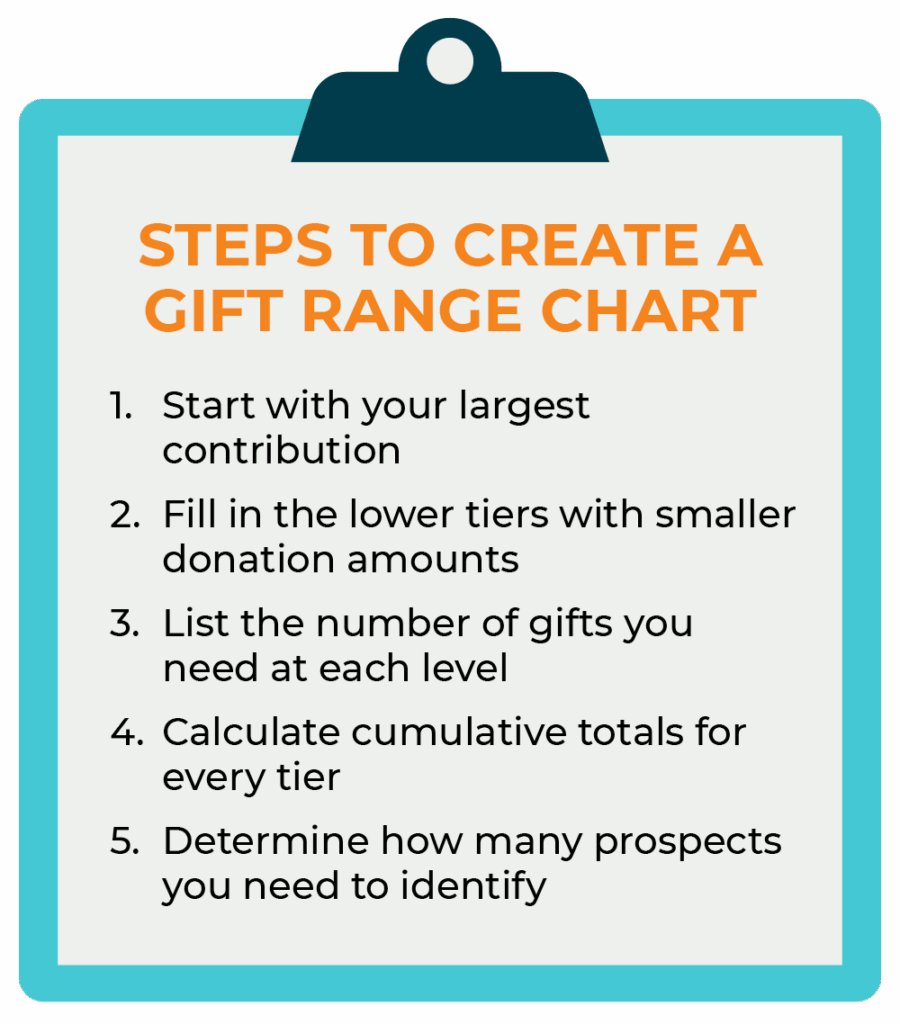
- Start with your largest contribution (sometimes called the lead gift), which should be approximately 15-25% of your total campaign goal.
- Fill in the lower tiers with smaller donation amounts—dividing the previous level by two is often a helpful starting point, but you also might create intermediate tiers or round your calculations if different amounts would be more useful to you.
- List the number of gifts you need at each level, starting with one for the lead gift and increasing as you go down the list.
- Calculate cumulative totals for every tier to ensure all of the gifts listed in the chart add up to your fundraising goal and adjust as needed.
- Determine how many prospects you need to identify by multiplying the number of gifts by four for the highest amounts on your chart, by three for the middle tiers, and by two at the lowest levels.
How your gift range chart looks will vary based on several factors, including your nonprofit’s size, donor base, and fundraising goal. Campaign type also heavily influences gift range chart structure. For example, an annual fundraising gift range chart would include a wider variety of tiers than one for the quiet phase of a capital campaign, since the latter specifically focuses on major donor fundraising and the former usually involves supporters at all giving levels.
DonorSearch’s Gift Range Chart Template & Calculator
Especially if it’s your first time creating a gift range chart, you might find it helpful to use a template or digital calculator as a starting point. Our team at DonorSearch has provided both options for you so you can test them out and decide which one is better suited to your needs.
Our gift range chart template includes columns for gift amounts, number of gifts, number of prospects, and cumulative totals. You may need to change the number of rows or otherwise adjust this template to cover all of the information you need, but you can download or print it to get you on the right track.
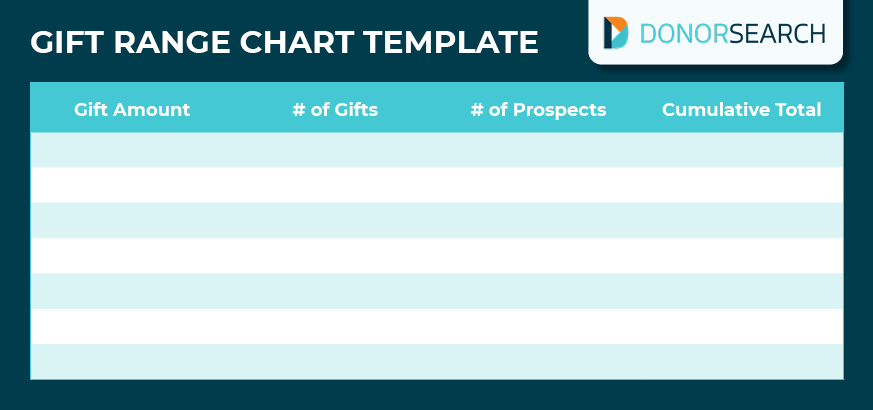
To use our gift range chart calculator, enter your fundraising goal and largest gift amount (you can also input the total number of prospects you want to include on the chart, but it’s optional) and click “Generate Gift Range Chart.” If you’d like to see different breakdowns of the same goal, you can click “Generate Variation” until you get the result you want. Like with the template, you may need to manually adjust the calculator’s outputs in your own document to create the best possible chart for your unique fundraising situation.
Additional Tips for Using Your Gift Range Chart
For your gift range chart to actually make your fundraising more effective, you should use it as a guiding document for your entire campaign. Try the following tips to get the most out of this resource:
- Build your campaign timeline around your chart. A gift range chart can give you an idea of how much time it’ll take to meet your campaign goal. By creating it early in the planning stage of your campaign, you can build the rest of your fundraising activities around it and come up with a realistic timeline for collecting the donations you need.
- Be efficient with your time by pursuing the largest gifts first. There is no set amount of time you should spend cultivating a major donor—it varies on a case-by-case basis and often takes weeks to months. By visually identifying how many major gifts you need to solicit, you can approach outreach and solicitation more efficiently, leaving more time for cultivation in between.
- Return to your chart throughout the campaign. Regularly compare the gifts you’ve secured to your plan so you always know where you stand in relation to your goal. Your gift range chart can also help you brainstorm your recognition strategy for donors in each tier (e.g., considering how many invitations you might send out for an event or how you’ll organize major donors’ names in your annual report).
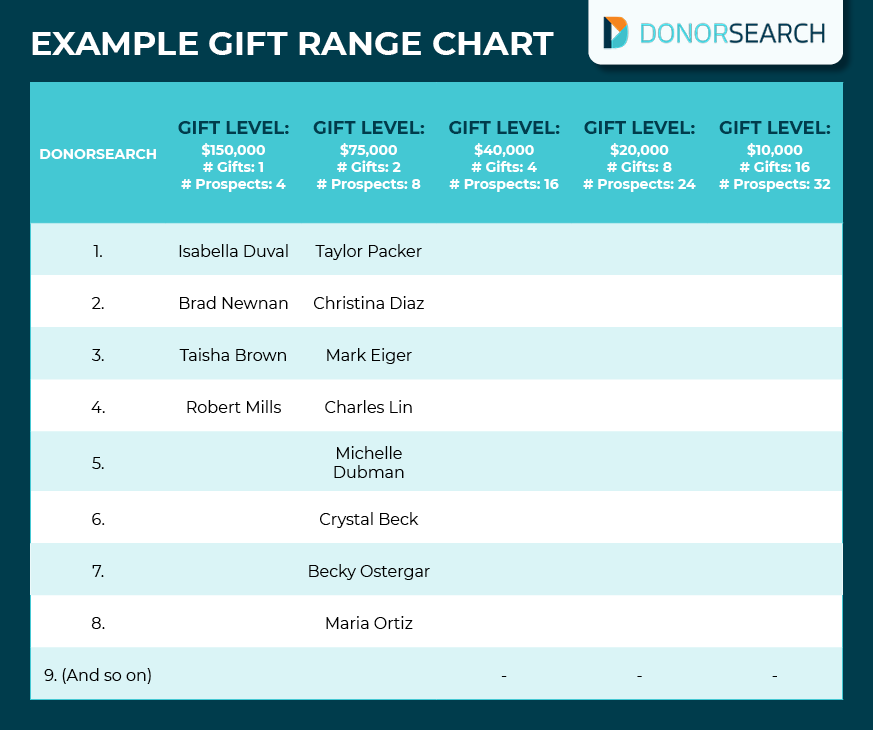
- Create a depth chart using prospect research findings. A depth chart takes the information in your gift range chart one step further by allowing you to identify specific prospects you could ask to contribute at each level (example below). Use the wealth and philanthropic data you uncover through research to organize your lists based on who is most likely to be able and willing to give the amount you’re looking for.
If you’re in the market for a prospect research solution that makes it easy to put your gift range chart into action, DonorSearch is your best bet. Our wealth and philanthropic screening tools pull from more than one billion data points to provide accurate, up-to-date information on your organization’s potential donors. And with our unique Most Likely to Respond (MLR) scores, AI-powered prospect reporting, and predictive modeling via DonorSearch Ai and Enhanced CORE, you can easily prioritize your depth chart and reach out to the best prospects first.
DonorSearch empowers nonprofits like yours to achieve greater fundraising results with less time and effort required. But don’t just take our word for it—check out this video to see how Ronald McDonald House Charities of Chicagoland and Northwest Indiana used our database insights and MLR scores to secure multiple seven-figure contributions:
Final Thoughts
Gift range charts allow your nonprofit to take a more intentional approach to soliciting donations and make consistent progress toward its largest fundraising goals. Use the tips and resources above to get started, and remember that the right prospect research tools (like DonorSearch!) can make all the difference in applying your charts to real campaigns.
For more information on gift range charts and their applications, check out these resources:
- What Is a Capital Campaign? Ultimate Guide for Nonprofits. Explore every aspect of conducting a capital campaign, including how gift range charts fit into that bigger picture.
- Major Gifts: How to Secure High-Impact Nonprofit Donations. Dive deeper into how to strategically collect the largest donation amounts on your gift range chart.
- 15+ Best Prospect Research Tools to Find High-Impact Donors. Discover a range of solutions and resources you can use to add depth to gift range charts.