
AI Fundraising: How to Build Your Nonprofit’s Strategy
Embracing change is essential for staying effective in a landscape that’s constantly shifting. The digital age has transitioned from a new frontier to an essential strategy for nonprofits, and a powerful driver of this evolution is fundraising artificial intelligence (AI).
While the learning curve can feel steep, the data shows that the sector has reached a definitive tipping point. As of late last year, 72% of nonprofit leaders reported that their organizations had already adopted AI technology. This mass adoption does more than boost efficiency—it future-proofs your organization’s fundraising strategy.
In this guide, we’ll help you bridge the gap between curiosity and impact by covering:
- AI Fundraising: Frequently Asked Questions
- Top Ways to Tap Into AI Fundraising
- How to Use Fundraising AI Responsibly
- Steps for Choosing AI Fundraising Tools
- DonorSearch’s Industry-Leading Nonprofit AI Solutions
By embracing AI, your organization can create personalized, efficient donor experiences at scale, ultimately driving better results for your mission.
AI Fundraising: Frequently Asked Questions
What is fundraising artificial intelligence?
Fundraising artificial intelligence is the use of machine learning and data modeling to predict donor behavior and automate personalized outreach. Fundraising AI is laser-focused on one goal: identifying the right donor, for the right gift, at the exact right time.
As you explore these tools, you’ll likely encounter the term “machine learning.” This is the process where an AI tool trains on your historical data (e.g., past gift sizes, communication preferences, and wealth markers) to identify patterns. For example, DonorSearch Ai processes billions of data points through mathematical algorithms to pinpoint prospective donors who are likely to give and become repeat contributors.
While AI excels at identifying patterns, it lacks sentience and emotional intelligence. It can tell you who is likely to give, but it cannot replace the human-to-human connection that converts a prospect into a lifelong champion. Treat AI as an assistant in your fundraising strategy by having it handle data analysis while your staff focuses on relationship building.
What are the primary types of AI fundraising tools?
Most nonprofit AI tools fall into one of two categories:
- Predictive AI: These tools analyze massive datasets to forecast future behaviors. DonorSearch Ai is a prime example. As the most advanced machine learning tool available to nonprofits, it analyzes prospect research data to identify who is most likely to become your next major donor. Other popular predictive AI tools include Tableau and Google Cloud Smart Analytics to help visualize trends.
- Generative AI: Once predictive AI tells you who to talk to, generative AI helps you decide what to say. These tools create written or visual content based on prompts. ChatGPT and Claude are popular general assistants, while nonprofit-specific tools like ProspectView Online 2 by DonorSearch leverage your nonprofit’s data to help your staff prepare for donor meetings, outreach, and other stewardship activities.
The best AI fundraising strategies incorporate both types of tools. Once you collect data and analyze it with predictive solutions, apply the results to create informed, tailored content aided by generative AI fundraising tools.
What role does AI play in fundraising?
There are dozens of ways AI can help your nonprofit improve its fundraising strategy. Most critically, it allows you to:
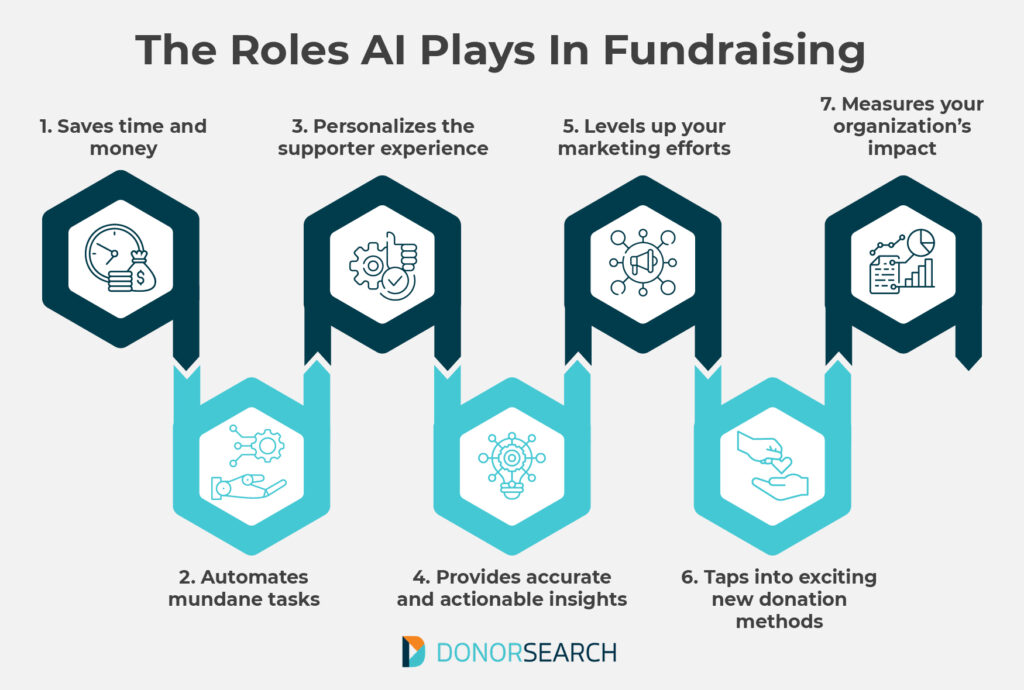
- Save time and money by allowing you to work smarter, not harder, on your campaigns.
- Automate mundane tasks so you can focus on more involved activities that require human oversight.
- Personalize the supporter experience through segmentation and tailored outreach.
- Provide accurate and actionable insights to maximize fundraising effectiveness.
- Level up your marketing efforts via high-quality content that resonates with its target audience.
- Tap into exciting new donation methods while still improving your existing campaigns to maximize donor engagement.
- Measure your organization’s impact to help you monitor progress over time.
The right platforms will increase your organization’s capacity to make a difference in your community by bringing new insights and capabilities to the table.
Will AI replace humans’ role in fundraising?
No. While AI is a powerful tool for efficiency, it cannot replace the fundamental human element that drives philanthropy.
Fundraising is built on trust, empathy, and shared values—all of which are qualities that an algorithm can’t replicate. Although AI can analyze data to find your most promising prospects or draft an initial email, it cannot have a genuine conversation with a donor, share their passion for your mission, or provide the emotion-driven gratitude needed to sustain a long-term relationship.
Instead, think of fundraising AI as a high-powered assistant rather than a replacement. It can help you automate repetitive tasks and free up your time to focus on what you do best: building authentic connections with donors.
Top Ways to Tap Into AI Fundraising
Now that you understand the basics of AI fundraising, you’re likely wondering how this translates into your daily workflow. The most successful contemporary nonprofits are using AI to solve specific, high-stakes challenges like donor churn and major gift stagnation. Let’s explore some of the top use cases to get you started:
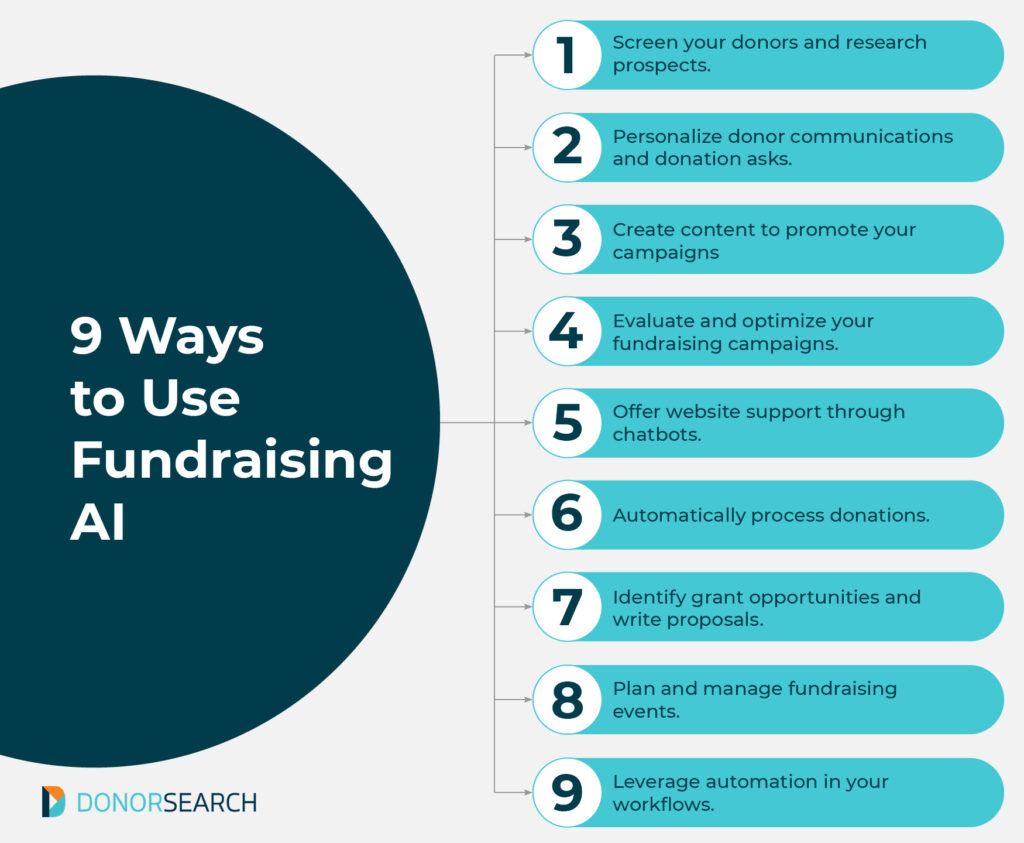
1. Screen Your Donors and Research Prospects
An important aspect of fundraising is being confident in your donation asks. Understanding potential donors’ wealth and philanthropic backgrounds helps you raise money more efficiently, build relationships with key players in your community, and ultimately reach your major gift fundraising goals.
One of the best ways to use AI in fundraising is to enhance your prospect research processes. Once you identify potential donors with a strong giving capacity, philanthropic history, and affinity for your mission, an AI-powered predictive modeling tool (such as DonorSearch Ai) can prioritize your prospect list according to how likely each individual is to respond to outreach, make a first gift, and become a long-term supporter of your nonprofit.
With these data-driven insights on your side, you can take on donor cultivation and stewardship tasks with confidence, designing strategies that you know will resonate with individual prospects and focusing your efforts on the most probable potential donors.
2. Personalize Donor Communications and Donation Asks
Today’s donors expect a high level of personalization from the organizations they support. They want to feel seen and valued for their contributions, and they want the nonprofits they care about to meet them where they are.
With AI fundraising tools, you can quickly and easily personalize donor communications. For instance, you might use predictive AI tools to learn about your supporters’ communication preferences and the types of outreach they’re most likely to respond to. From there, you can segment supporters based on shared characteristics and use generative AI tools to help you create tailored messages for each segment.
Additionally, each donor wants to be asked to give in a way that appeals to them—including the appeal method, contribution amount, and gift designation. Using artificial intelligence to learn about individuals’ needs and expectations helps scale your efforts and make more successful donation requests.
3. Create Content to Promote Your Efforts
No matter how long you’ve been fundraising, you know that half the battle is spreading the word about your campaigns. This is another instance in which generative AI can be especially helpful, as it can develop all types of marketing materials, such as:
- Website page copy and blog post drafts
- Email and direct mail messages
- Social media graphics, captions, and posting schedules
- Presentation slides and agenda talking points for live meetings
- Professional-looking videos to use across all of these platforms
When using AI to create content, remember to always have a human member of your team revise the tool’s outputs. This will help ensure your messages stay on brand and contain personal touches that donors resonate with. You should also check that your AI tools prioritize accessibility through factors such as ensuring adequate color contrast, adding alternative text to images, and generating closed captions for videos (or edit these aspects yourself).
4. Evaluate and Optimize Your Fundraising Campaigns
Part of being an effective fundraiser is learning from past successes and challenges. Fundraising artificial intelligence can help you evaluate previous campaigns by examining:
- Campaign data, producing metrics that demonstrate key patterns and trends.
- Campaign budgets, helping you determine how to allocate future funds to achieve the greatest ROI.
- Supporter feedback, giving you insight into how your community perceived past campaigns and how they might react to future strategies.
- Donor journeys during past campaigns, letting you identify the most effective marketing channels and the best fundraising methods.
When you critically evaluate your past fundraising campaigns, you can see what has and hasn’t worked and make plans to boost your success in the future.
5. Offer Website Support Through Chatbots
Imagine someone decides to donate on your organization’s website outside your operating hours. They arrive on your donation page intending to give generously, but in the middle of the donation process, they have a question that halts their progress. With no one to get in touch with, they abandon your form, saying they’ll come back later (which may or may not actually happen).
You can avoid situations like this by adding an AI-powered chatbot to your website. These bots can answer common questions for website visitors and direct them to the resources or information they’re looking for. The great thing about a chatbot is that it’s there around the clock, ready to help your website visitors whenever they decide to visit your site.
6. Automatically Process Donations
Some AI tools can help your nonprofit process payments securely, capture important donor information, generate tax receipts, attribute donations to specific campaigns or programs, and even detect fraudulent activity.
By using AI to track donation flow, you can help your organization manage its finances effectively, use donations for their intended purposes, and free up time to focus on recognizing and stewarding donors, all while reducing the risk of human error.
7. Identify Grant Opportunities and Write Proposals
Grants are an important funding source for many nonprofits. However, it takes time to identify opportunities that match your organization’s needs and write a standout proposal for each grant that aligns with the funder’s requirements.
AI can speed up the process, helping you find grant opportunities along with their eligibility criteria and deadline information. Some tools can even help you draft your proposals and give you suggestions to make your organization stand out from the crowd.
8. Plan and Manage Fundraising Events
Fundraising events are a chance for your community to come together, participate in fun activities, make memories, and give generously. But pulling off a successful event is often easier said than done!
An AI tool built for events can help you streamline many parts of the planning process, from brainstorming to budgeting to marketing. These solutions can also help you gather and analyze attendee feedback after your event is over. This way, you’ll have insight into what participants liked and disliked about your event so you can adjust your strategy in the future.
9. Leverage Automation in Your Workflows.
A major selling point of AI is that it can save your team precious time and energy by automating the mundane tasks in your fundraising workflows, such as inputting data, managing your social media presence, or taking notes in meetings.
When you automate these “busy work” tasks, you have more time for fundraising work that matters most—identifying donors, developing relationships with them, requesting gifts, and retaining their support long-term.
How to Use Fundraising AI Responsibly
Maintaining donor trust is the most critical part of your nonprofit’s AI journey. While your team may be excited about better efficiency, your supporters are watching closely, and some may have their hesitations. In fact, 77% of major donors say they’d pay attention to what a nonprofit they supported said about their AI usage. Interestingly, acceptance varies by donor type: 64% of mid-level donors and 48% of small donors said they’d pay attention to nonprofits’ AI usage.
For your nonprofit to tap into the benefits of AI while maintaining trust with its community, your organization should commit to using fundraising AI responsibly. For the best results, follow the Responsible AI Framework developed by the Fundraising.AI collaborative. Its tenets include:
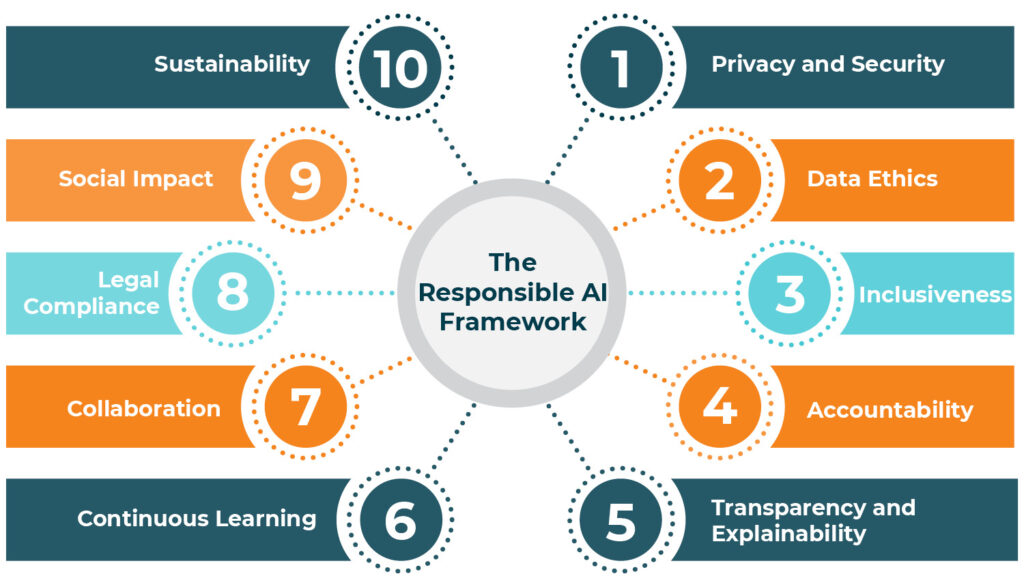
- Privacy and security: Safeguard all donor data through rigorous encryption and secure storage to prevent unauthorized access.
- Data ethics: Ensure all information is collected with proper consent and used in ways that align with your mission.
- Inclusiveness: Actively audit AI tools to prevent bias and ensure all donor segments are represented fairly.
- Accountability: Assign specific staff members to oversee AI outputs and take responsibility for the technology’s impact.
- Transparency and explainability: Be open with stakeholders about when AI is used and how it reaches its conclusions.
- Continuous learning: Stay updated on evolving AI regulations and best practices to remain an ethical leader.
- Collaboration: Share insights and challenges with the broader nonprofit community to improve the sector’s AI standards.
- Legal compliance: Adhere to all data protection laws, such as GDPR or CCPA, regarding automated processing.
- Social impact: Prioritize the well-being of the communities you serve over the speed of technology.
Establishing these principles effectively involves creating a formal AI acceptable use policy. Despite high adoption rates, 76% of nonprofits still have no formal AI policy in place, leaving them vulnerable to data privacy risks and public distrust. Creating your own policy involves auditing your current tools, defining off-limits actions (e.g., never putting personally identifiable supporter information into public AI chatbots), and establishing a clear disclosure statement for your donors. To create a sound policy, it’s best to work with a legal expert.
Once your AI policy is approved by the board and leadership, your nonprofit and its donors will feel more comfortable knowing that their information is protected. From here, stay on top of fundraising artificial intelligence best practices and monitor updates in the AI regulatory landscape so you can make the most of your tools.
Steps for Choosing AI Fundraising Tools
At this point, you’re likely ready to begin shopping for your own AI solutions. Follow these steps to ensure you invest in tools that will help you achieve the greatest ROI for your mission while meeting all of your organization’s needs:
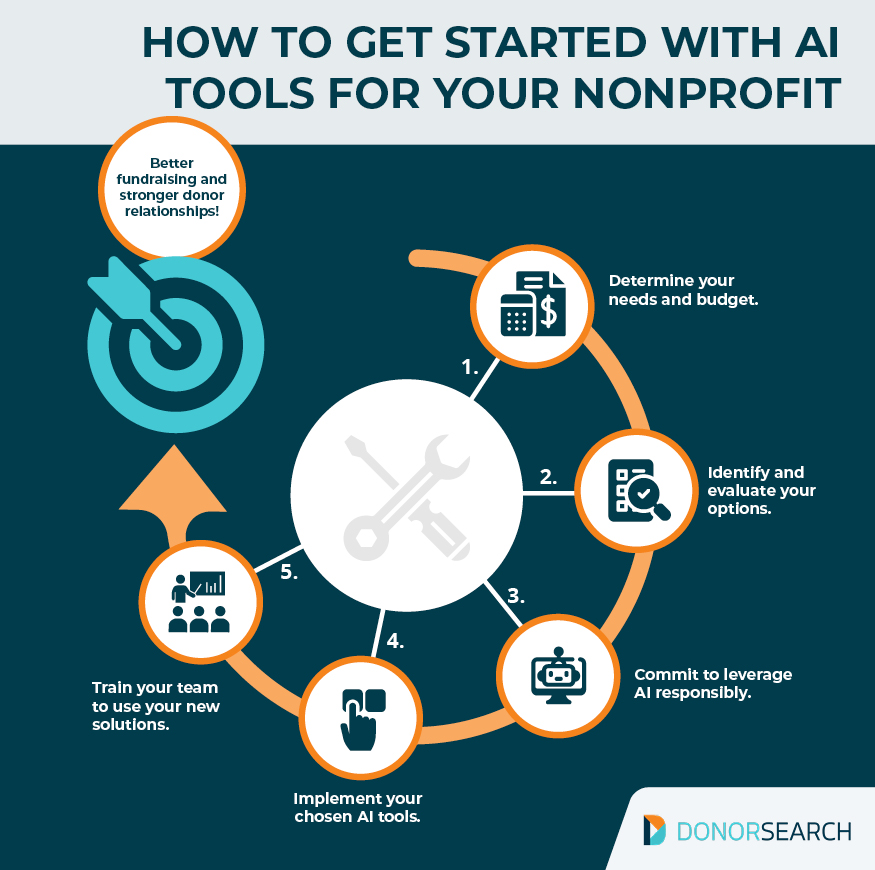
- Determine your needs and budget. Before you start looking at different tools or providers, determine your organization’s goals for incorporating AI into its fundraising strategy. For instance, maybe you want to strengthen your major giving program or submit more grant proposals. You should also decide how much money you can invest in AI tools at this stage.
- Identify and evaluate your options. Next, review lists of top AI fundraising solutions or ask trusted nonprofit colleagues for their recommendations. Read up on each tool, its features, its pricing model, and user reviews. You should also look into the providers you’re considering to make sure their values align with your nonprofit’s.
- Commit to leverage AI responsibly. Before adopting any tools, consider creating an AI policy for your entire organization to follow, outlining how you’ll maximize benefits and minimize risks associated with fundraising AI. Then, share these guidelines with your community to promote transparency and trust.
- Implement your chosen AI tools. Once you’ve chosen one or more AI fundraising tools (remember that the most effective strategies combine generative and predictive AI), it’s time to get up and running! Work with your provider to understand the ins and outs of each feature and ask questions as needed so you can integrate your new platforms into your workflows without a hitch.
- Train your team to use your new solutions. Hold informational sessions for staff members on how to use your chosen tools, working with providers as needed. Emphasize that the goal of using AI in your fundraising strategy is to make your processes more streamlined and efficient so your team can focus on the uniquely human aspects of nonprofit work.
Purchasing fundraising artificial intelligence solutions isn’t just a one-time investment—it’s a fundamental shift in how your nonprofit works to raise money for its mission. Use the buying experience as an opportunity to position your organization to get the most out of its chosen tools and to leverage AI responsibly from the beginning.
DonorSearch’s Industry-Leading Nonprofit AI Solutions
As the longtime leaders in nonprofit prospect research, DonorSearch has evolved to provide top-tier AI fundraising solutions that meet the demands of modern nonprofits. Our goal is to help your organization seamlessly and responsibly integrate AI into its prospecting and donor outreach processes. Our tools empower you to future-proof your efforts and streamline time-consuming aspects of donor identification and cultivation.
DonorSearch offers a suite of nonprofit-specific tools that leverage the unique strengths of both generative and predictive AI:
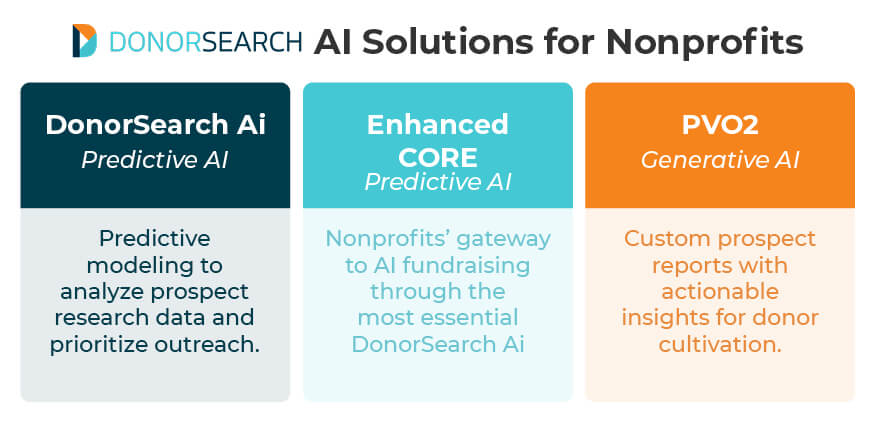
- DonorSearch Ai: A comprehensive machine learning solution that provides custom predictive modeling of prospect research data for more effective outreach prioritization and donor pipeline creation.
- Enhanced CORE: An entry-level version of DonorSearch Ai with point-and-click visualization and standardized predictive models to help you get started more easily.
- ProspectView Online 2: A generative AI-powered prospect reporting tool that summarizes the most important and actionable information on each potential donor you identify to guide cultivation.
With accurate insights from DonorSearch’s predictive and generative AI tools on your side, your team can approach every donation request and relationship-building activity with data-backed confidence.
But don’t just take our word for it—watch the video below to see how the Children’s Healthcare of Atlanta Foundation used DonorSearch Ai to help secure critical major gifts from donors they had previously overlooked in their prospecting efforts:
Final Thoughts
It’s time for your nonprofit to embrace AI, streamline your cultivation efforts, and future-proof your mission! By integrating fundraising AI into your workflow, your organization can move past the limitations of manual data and best-guess outreach.
Whether you’re looking to boost your average gift size or identify the hidden major donors already sitting in your database, the tools and strategies above provide a roadmap for responsible, high-impact growth.
For more information on mastering AI fundraising, check out these additional resources:
- AI for Nonprofits: Everything Your Org Needs to Know. Discover even more fundraising and operational uses for AI at your nonprofit.
- Generative AI vs. Predictive AI: A Complete Nonprofit Guide. Dive deeper into the distinct benefits and use cases of the two major types of AI solutions.
- Fundraising Intelligence: Using AI to Enhance Philanthropy. Learn how and why to leverage donor analytics for better fundraising results.