
Major Gifts: How to Secure High-Impact Nonprofit Donations
Although every donation counts in nonprofit fundraising, major gifts are especially critical to your organization’s success. These large, transformative donations allow you to fund ambitious projects, launch new programs, plan for growth, and otherwise make the impact you hope to have on your community.
To successfully solicit these high-value contributions, your nonprofit needs a clear major gifts strategy. In this guide, you’ll learn all you need to know to develop or improve your approach to major donor fundraising, including:
- Major Gifts FAQ
- Overview of the Major Donor Lifecycle
- Steps to Launch a Major Giving Program
- Essential Tools for Major Gift Fundraising
Let’s get started by discussing what major gifts are and why they matter for nonprofits like yours.
Major Gifts: Frequently Asked Questions
What are major gifts?
Major gifts are the largest contributions your nonprofit receives from individual donors. These donations make a significant difference in funding your organization’s most important projects and programs.
In most cases, donors will specify which of your initiatives they want their contribution to support. Major gifts usually require one-on-one cultivation and strategic solicitation to secure (more on this later!), but their impact is well worth the upfront investment of time and effort.
What donation amounts count as major gifts?
There is no sector-wide standard amount for what qualifies as a major gift. What your specific organization considers a major gift depends on a variety of factors, such as your nonprofit’s size, fundraising history, and average donation amount. You can calculate your major gift threshold or range by following these steps:
- Create a list of all donors and donations from the past year.
- Organize the list by gift size, ordered from largest to smallest.
- Take the average of the largest gifts. Small organizations might just use the top three for this calculation, while large nonprofits may find the average of 10 or more gifts.
The result is your major gift threshold, a cutoff point to help you identify which of your nonprofit’s donations are truly major. For some organizations, $2,000 might be a major contribution, while others might have a cutoff of $100,000. Note that your threshold can change as your nonprofit and its supporter base grow.
Additionally, major donors often pay out their gifts in installments or contribute them through a combination of cash and other assets like stocks or donor-advised fund (DAF) grants. But if the total value of their contribution exceeds your threshold, it’s a major gift.
Why is major gift fundraising important?
It’s estimated that 80% of individual donation revenue to nonprofits comes from the top 20% of donors. For some organizations, the ratio is closer to 90/10. Because these gifts make up such a large chunk of your fundraising revenue, they’re one of the biggest driving forces behind your team’s ability to enact greater change for more people.
In particular, major gift fundraising can provide your nonprofit with:
- Strong donor relationships that lead to long-term support, loyalty, and advocacy.
- Increased organizational capacity to pursue ambitious projects and achieve impactful outcomes.
- Efficient revenue generation—after all, you’re bringing in thousands of dollars from just a few donors!
Naturally, you’ll maximize these benefits if you use the right tools (more on that topic later!), create a strong strategy, and iterate on your process so it becomes more streamlined and successful over time.
Overview of the Major Donor Lifecycle
To secure major gifts, you have to approach donor cultivation with care. From the moment you discover a prospect to when it’s time to ask for a donation (and beyond), prioritize building a strong relationship with that prospect and make it clear to them that your organization values their individual support.
The major donor lifecycle (also known as the donor management lifecycle or donor journey) is a helpful tool for honing your approach. It visualizes how an individual goes from an unengaged prospect to a loyal supporter of your mission, allowing you to plan the specific moves you’ll use to get them to progress from one step to the next. Let’s look at the stages of this lifecycle in more detail.
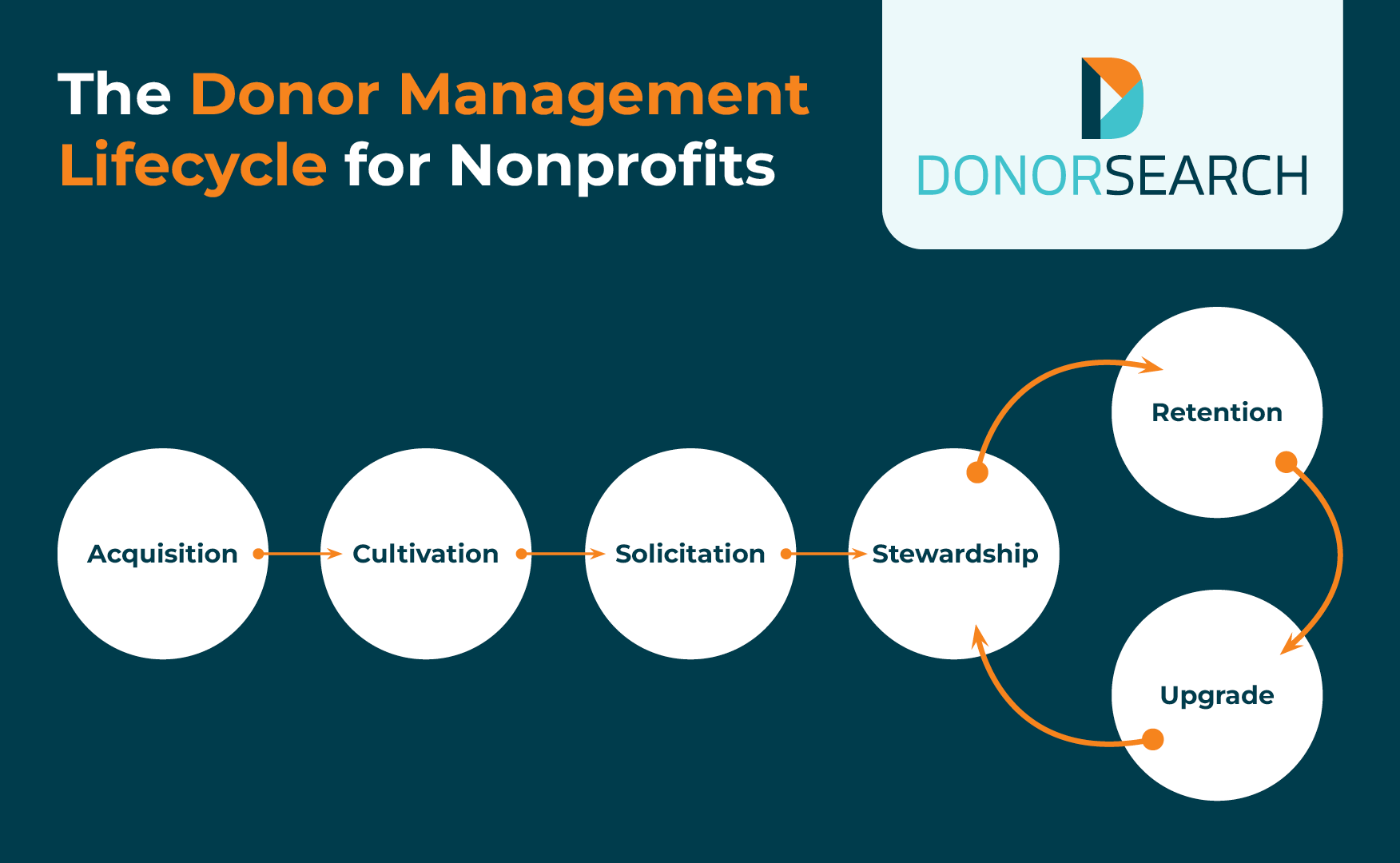
Acquisition
The first step in major gift fundraising is to identify and reach out to potential donors. Because only a few supporters are well equipped to become major donors, it’s vital to take time and use the data available to you to pinpoint these prospects.
Prospect research is the process of finding data on individuals currently in your donor database and beyond that indicates whether they would be good major donors. It should be a cornerstone of your major giving efforts, whether you’re working on a capital campaign, annual fundraising, or another initiative.
To truly know who your best prospects are, you need to conduct wealth and philanthropic screenings. This holistic approach to prospect research uncovers whether individuals would be both able and willing to make a large contribution to your nonprofit by looking at the following three types of data (also known as markers or indicators):
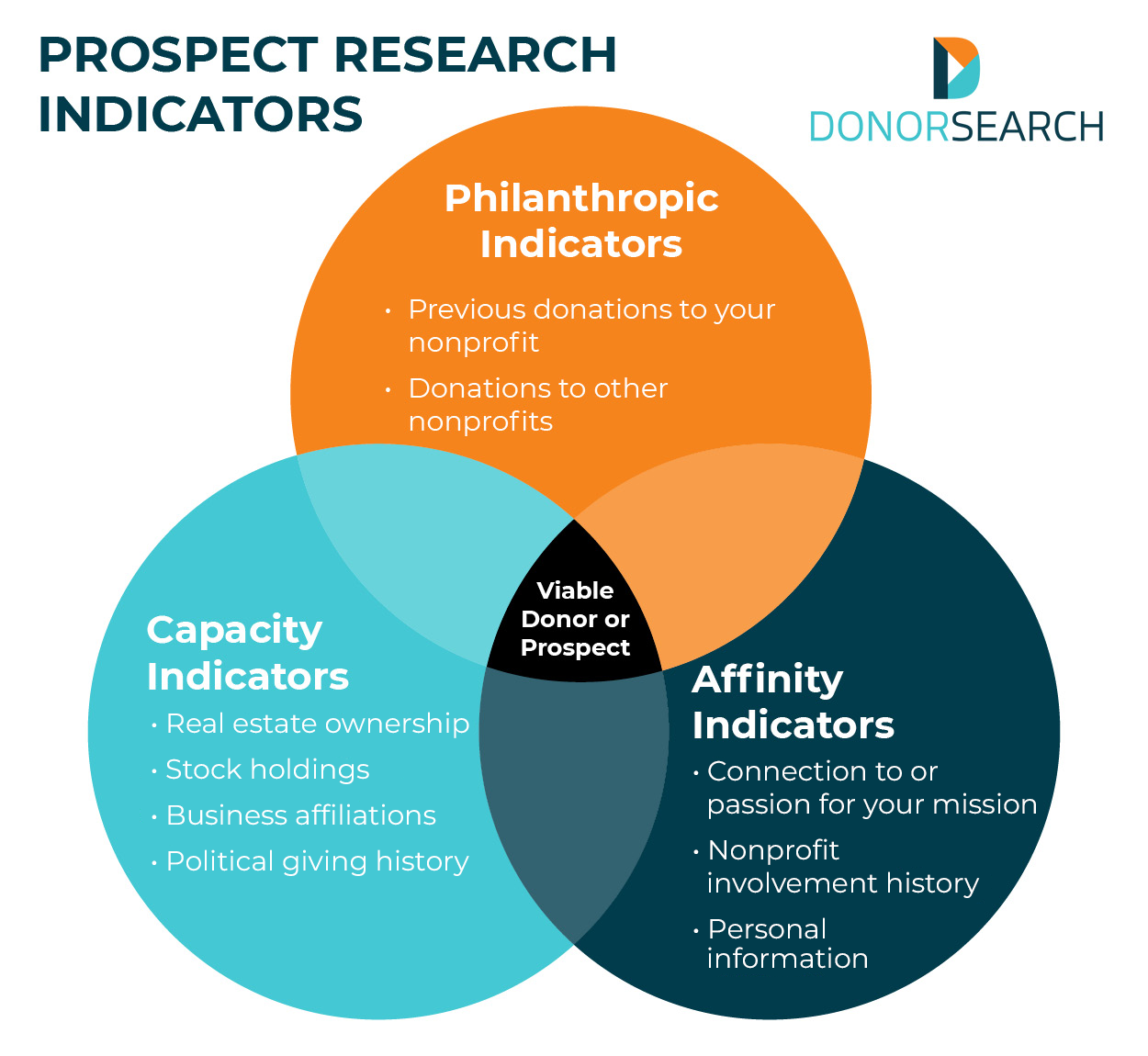
- Capacity indicators are signals of a potential donor’s financial capability to give at or above your organization’s major gift threshold. They include real estate ownership, stock holdings, business affiliations, political giving history, and similar wealth data.
- Philanthropic indicators demonstrate that a prospect has general charitable tendencies. Past donations to your nonprofit or other similar organizations are the best markers of a philanthropic prospect.
- Affinity indicators show that someone would be inclined to support your specific nonprofit. They include a connection to or passion for your mission, a history of nonprofit involvement beyond donating (e.g., via attending events, volunteering, or serving on a board), and other relevant personal information like interests and values.
The stronger a potential donor’s markers are across the board, the more likely they are to be a viable prospect for your nonprofit, meaning you should prioritize reaching out to them. Keep your prospect research findings handy throughout the donor journey and regularly check for updates, since this information can also be useful at other stages.

Cultivation
Once you’ve identified prospects and made first contact with them, the cultivation stage involves team members connecting with each individual donor and learning more about them. When you go through this process, the eventual donation solicitation is better informed and more likely to resonate with the prospect.
To cultivate a relationship with each prospective major donor, you should:
- Schedule a one-on-one meeting where you introduce the prospect to your organization’s mission and current initiatives and get to know them personally in a casual setting.
- Send follow-up communications to keep your organization top of mind, answer any questions they had during the initial meeting, and introduce other staff or board members they might be interested in talking to.
- Invite them to experience your mission in action, whether that’s through a special volunteer opportunity, an office tour, or a VIP event invitation.
Focusing on cultivation before asking for a major gift is critical for ensuring that each prospect feels like a valued partner of your organization. Plus, potential donors can learn more about your nonprofit, mission, and fundraising needs before deciding how to contribute.
Solicitation
There is no set amount of time you have to spend cultivating prospects—you’ll need to determine when the time is right to solicit a major gift on a case-by-case basis. When the time comes to prepare and present your donation request, make sure to:
- Review what you’ve learned about the prospect. The more you know about your prospects, the better equipped you’ll be to make an ask they’ll be receptive to. By leveraging prospect research wealth data, you can determine a reasonable amount to request. You may also use what you’ve learned about their interests and values to suggest a designation for their gift.
- Create presentation materials in advance. To make your case for why a potential donor should support your cause, gather resources such as your organization’s mission statement, financial reports, success stories, and testimonials. Then, plan out the structure of your oral presentation and draft a donation request letter as a leave-behind. Both of these pitches should feature compelling narratives and proactively address the prospect’s potential questions.
- Expect to negotiate. Start with an ask amount that’s reasonable given the prospect’s financial situation but doesn’t risk leaving any money on the table. From there, negotiate with them until you arrive at an amount where you and the donor both feel comfortable.
Not every prospect will be ready to give immediately, and that’s okay! Have a plan in place to follow up after they’ve had some time to consider your ask. Depending on their response, you may need to confirm a donation, send more information, or try a new approach. And if a donor is unable to say yes to a donation request now, that doesn’t mean they won’t be willing or able to give at another time!
Stewardship, Retention, & Upgrade
The last three steps of the donor journey are cyclical and overlap significantly. Once a donor has committed to making a major gift, it’s critical to continue building and prioritizing that relationship by first showing your gratitude, then maintaining their involvement with your mission, and finally getting them to increase their support.
Here are some tips for navigating the stewardship, retention, and upgrade stages of the major donor lifecycle:
- Correlate gratitude with contributions. Successful major donor appreciation goes beyond simple gift acknowledgments—the size of your thank-you should match the size of the donation. Hosting appreciation events, spotlighting donors on social media or in your annual report, creating physical or virtual donor walls, and offering naming rights to programs or areas of your facility are all great ways to recognize and steward major donors.
- Communicate additional opportunities for support. While you shouldn’t ask for another sizable monetary donation right away (doing so can lead to donor fatigue), you can offer other ways for donors to stay engaged with your mission. Volunteering, attending events, advocating for your cause, and contributing in-kind gifts of goods or services are all great options to deepen donors’ loyalty and passion for your mission.
- Demonstrate impact in detail. Because they’re giving a substantial sum to your organization, many major donors understandably want to know exactly how you’re using their gifts to further your mission. Provide comprehensive information about the work and projects impacted by their contribution so they can better visualize how their donations are making a difference.
Just like with the initial solicitation, there is no exact amount of time to wait before asking a major donor for another gift, especially a larger one. Track your interactions with them and revisit your prospect research tools to decide when to make your next request. Once they contribute again, promptly thank them for their gift and continue your retention efforts with the eventual goal of another upgrade.
Steps to Launch a Major Giving Program
Your nonprofit’s major gift fundraising efforts will be much more efficient and effective if you concentrate them into a dedicated program. Here are the basic steps for launching one.
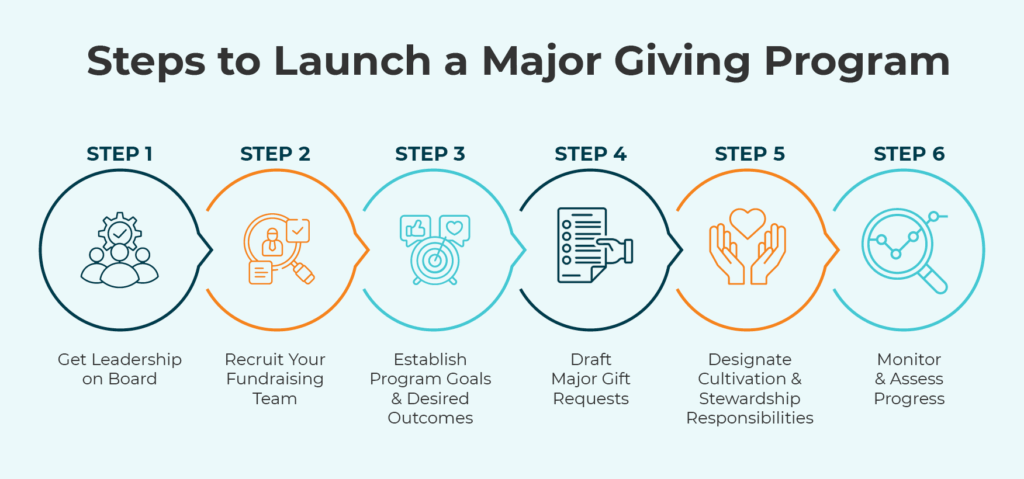
1. Get Leadership on Board
Successful major gift fundraising requires everyone on your team to be involved in some way. So you’ll need as much support from your leadership team as possible to get your program off the ground.
One effective technique for cultivating major donors is to introduce them to your organization’s executive director or board chair. Your leadership team and board members also likely have valuable major donor connections and may be able to start some conversations with prospects. But to make the most of these opportunities, ensure your organization’s leaders approve of your program and efforts from the start.
2. Recruit Your Fundraising Team
In addition to having your leadership on board, you’ll also need to build a major gift team. This team should include supportive board members, skilled fundraisers, experienced prospect researchers, and marketing specialists. And, of course, you’ll need a major gift officer (MGO) to lead the charge. Some organizations may be able to assemble this team with the staff they already have, while others may need to hire for positions like the MGO.
This team’s key responsibilities might include:
- Determining your organization’s major gift threshold
- Identifying prospects and selecting the best candidates
- Leading cultivation and solicitation efforts
- Designing stewardship and retention strategies
Team members should have an extensive familiarity with fundraising, excellent communication skills, a willingness to power through challenges, and a passion for your mission.
3. Establish Program Goals & Desired Outcomes
Before you start acquiring and cultivating donors, make sure everyone is on the same page about what you want your program to accomplish, both generally and in the near future. These goals—which might involve soliciting a certain number of major gifts over the next year or securing funding for a specific campaign—provide an essential framework for your program.
Additionally, when a major donor gives to your organization, they expect to see tangible outcomes from their contribution. They also might expect perks in exchange for their gift. Establish how you’ll report major gift results and what incentives you’ll offer with your team so they can communicate them clearly to prospects.
4. Draft Major Gift Requests
Once you have some prospects in the pipeline, you’ll want to start thinking about solicitation, since that step will determine if your program can achieve its goals. Here are some tips for making compelling asks:
- Personalize your appeals. Leverage the relationship you’ve built with each prospect to craft the most effective request possible. Make sure to use donors’ preferred names in letters, emails, and in-person conversations and pay attention to the level of formality they prefer.
- Summarize the available options. Present prospects with a few different campaigns or programs that their gift can support. These options allow the supporter to give to the aspect of your work they’re most passionate about. Guide donors toward areas that particularly need support, but make it clear that they have the option to designate their money as they see fit.
- Align your goals. Explain how each gift fits into the bigger picture by showing how the prospect’s specific interests align with your nonprofit’s goals. Once you’ve determined philanthropic interests and objectives, show them how they can serve those interests through making a major gift.
As mentioned above, you should make direct, specific asks in these requests but allow for adjustments as you talk to each prospect. Additionally, you can make this process more efficient by dividing solicitation responsibilities between team members and creating customizable templates for pitches and request letters.
5. Designate Cultivation & Stewardship Responsibilities
Because there likely aren’t an overwhelming number of major donors within most donor pools, you should take the time to cultivate meaningful relationships with each and every one of them. Divide up responsibilities among your major gifts team to ensure each existing and potential donor gets the attention they need to become a loyal supporter of your mission.
Assign each prospect or donor to a specific team member so they have a consistent point of contact with your organization, allowing for a stronger bond to form. This person might shift between cultivation and stewardship if you have team members who specialize in one or the other, but each staff member should generally have their own group to focus on within your program.
6. Monitor & Assess Progress
It’s always a good idea to set and evaluate key performance indicators (KPIs) when implementing any new nonprofit strategy. For your major gifts program, consider tracking the following fundraising metrics to measure its success:
- Major gift program ROI: This metric calculates how much money you’ve raised per dollar spent. To calculate it, simply divide the net revenue from major gifts by the total cost of the program. If the number is greater than 1, your efforts have been profitable.
- Average major gift size: This is simply the average amount of money your nonprofit receives from each major gift. Divide your total major giving revenue from a certain time period by the total number of major gifts you’ve received in that same frame to get this number.
- Major donor retention rate: Your major donor retention rate is the percentage of major donors who give more than once over a certain period of time. First, divide the number of repeat major donors by the total number of major donors, then multiply by 100.
- Average giving capacity: Giving capacity is an informed estimate of how much each donor can give and can help you make more targeted, accurate donation requests. Calculate it similarly to average major gift size, then compare the two numbers to ensure there isn’t a sizable discrepancy.
- Number of major gift asks made: This metric tracks how many times your major gift officers have requested a donation. Keep a running tally to ensure that you reach your target number of solicitations without asking the same donor too often. You should also note how many of your asks were successful along with the total number.
Although the exact KPIs you track will depend on your organization’s goals and program structure, these analytics are particularly helpful for assessing how your major giving efforts are going and their impact on your overall fundraising. To make the most of these data points, continuously track them over time and adjust your strategy as needed.
Essential Tools for Major Gift Fundraising
Like with any fundraising strategy, having the right technology can drastically simplify major giving while maximizing the revenue you bring in. Although there is a wide range of software to choose from, the most critical solutions to add to your toolkit include:
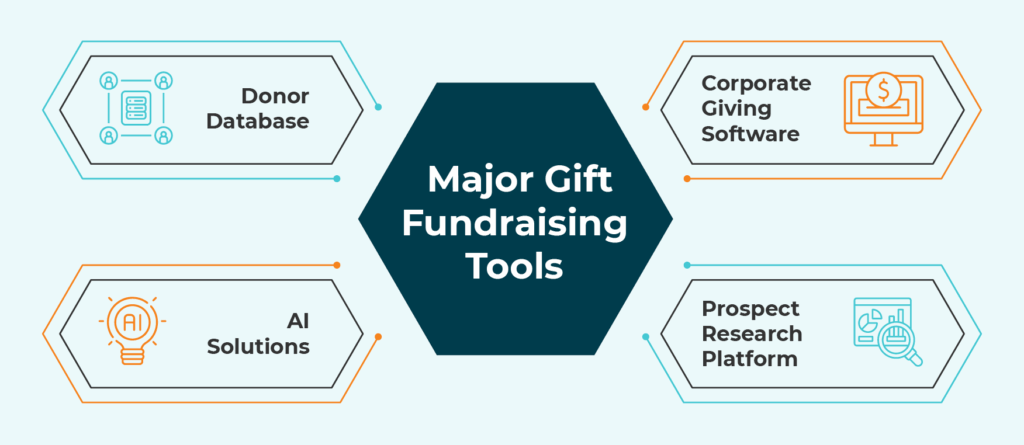
- A robust donor database where you can easily create individual profiles for each current and prospective major donor and consolidate all of your data in one place.
- Corporate giving software so you can tap into the programs your major donors’ employers offer, such as matching gifts or sponsorships, and increase your revenue.
- A prospect research platform that provides accurate, up-to-date information on current and potential major donors to frame every aspect of the donor lifecycle.
- AI fundraising solutions to enhance your prospect research analysis and application via predictive modeling and report generation.
If you’re shopping for new software in the last two categories mentioned above, look no further than DonorSearch! Our prospect research solution draws from the largest philanthropic database in the world (consisting of more than one billion data points), boasts an accuracy rate above 90%, and provides a balanced view of potential donors’ capacity, philanthropic, and affinity indicators. Plus, our platform integrates with more than 40 donor databases and fundraising tools, so you can seamlessly transfer major gift program data between solutions.
DonorSearch is also a leader in the AI fundraising space. We offer two options for predictive modeling—the entry-level Enhanced CORE and the more advanced and customizable DonorSearch Ai—both of which pinpoint the prospects who are most likely to become major donors to your organization through advanced analytics. Our generative AI-powered solution, ProspectView Online 2, produces individualized reports on each of your top potential donors so you can quickly reference their most important data points throughout the cultivation process.
DonorSearch’s full suite of tools empowers your nonprofit to secure even more major gifts and create a thriving program. But don’t just take our word for it—check out this video to learn how the Wildlife Conservation Society added more than 800 prospects to its major giving pipeline per year by investing in DonorSearch’s database and integrating it with Salesforce:
Final Thoughts
Major gifts have a significant impact on your organization’s mission, although they tend to require more time, planning, and resources to secure than a typical-sized donation. Whether you’re launching a major giving program for the first time or want to optimize your existing strategy, the tips and resources in this guide will provide a strong foundation for securing critical funding and building lasting donor relationships. Happy fundraising!
For more information on major gift fundraising, check out these resources:
- Donor Acquisition: How to Attract High-Impact Supporters. Discover more strategies for identifying and reaching out to brand-new supporters—especially potential major donors—about contributing to your organization.
- How to Create a Capital Campaign Plan That Gets Results. Explore the essential steps for planning a capital campaign, including how to bring in the 60-70% of your fundraising goal that will come from major gifts.
- AI Fundraising for Nonprofits: Embracing the New Frontier. Dive deeper into the role that tools powered by artificial intelligence can play in major gift fundraising and other aspects of nonprofit revenue generation.