Wealth Screening: Why It Matters & How to Get Started
In 2025, total nonprofit donation revenue increased by 5%, but the overall number of donors decreased by nearly 4% year over year. The sector has long recognized the importance of major giving in nonprofit revenue generation models, but these recent shifts make it clear that large-dollar donors now play a more important role in fundraising than ever.
So, how do you find these major donors, given that different supporters have different giving capacities? The answer is by conducting wealth screening!
Read on to learn more about what wealth screening is, why it’s important for nonprofits like yours, and how to develop an effective process for it.

Reach beyond the limits of traditional wealth screening with the top prospect research and AI fundraising tools on the market.
Wealth Screening: Frequently Asked Questions
What is wealth screening?
Wealth screening is the process of assessing current and prospective donors’ capacities to give to your nonprofit. It involves gathering and analyzing comprehensive information about donors’ financial situations to estimate their total wealth, which then helps you determine whether they could make a large charitable donation.
What is the difference between wealth screening and prospect research?
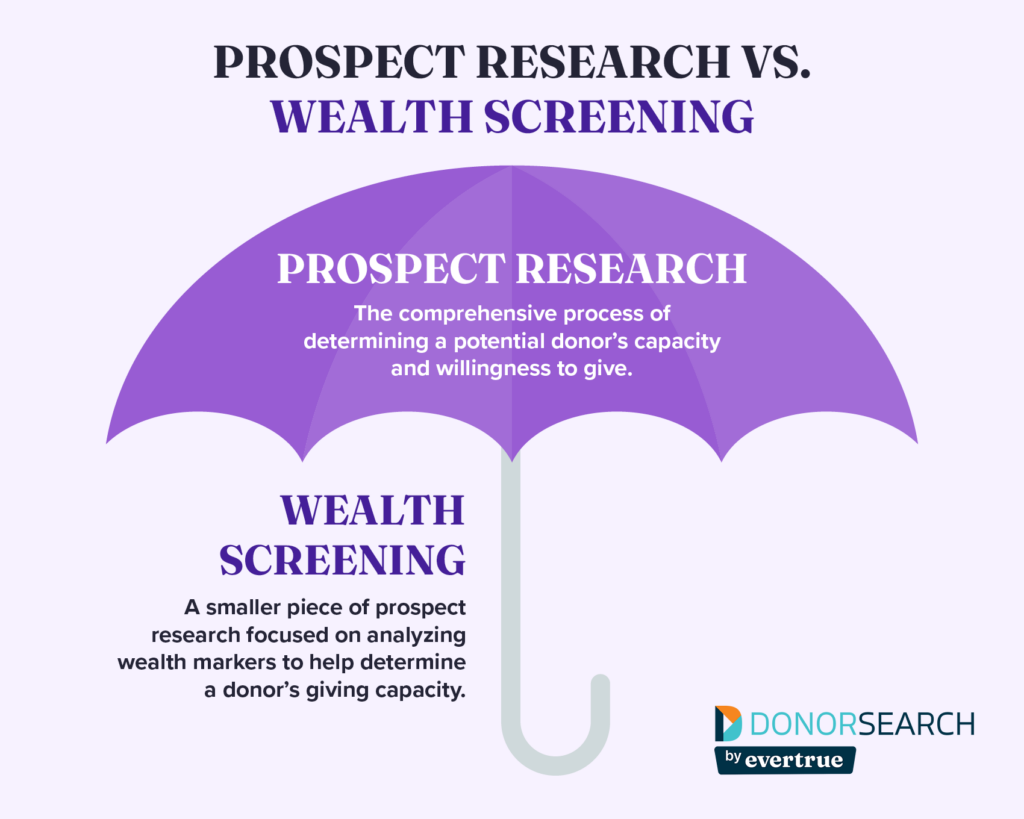
Wealth screening is essentially a subset of the more comprehensive process of prospect research. While wealth screening focuses on giving capacity, prospect research takes donor data collection a step further by also assessing donors’ willingness and likelihood of contributing to your specific organization. After all, just because a donor could make a significant gift to your organization doesn’t necessarily mean they’d want to do so.
To reflect the relationship between wealth screening and prospect research, some organizations refer to their data-gathering processes for major giving as “wealth and philanthropic screening,” “prospecting,” or simply “screening.” Wealth screening and prospect research are also sometimes used interchangeably, although their core definitions are different.
What does wealth screening help nonprofits accomplish?
Wealth screening can support many aspects of your nonprofit’s fundraising work, including:
- Identifying potential major donors both within and outside your current supporter base
- Planning donation requests so you ask each donor for the right amount in the right format (especially if they might give through non-traditional vehicles like stocks or DAFs)
- Setting realistic campaign goals and creating gift range charts that will get you to those goals by providing giving amounts donors are likely to take you up on
- Developing large-scale fundraising initiatives such as planned giving, endowment funds, or segmented mission-specific programs (grateful patients, alumni gifts, etc.)
- Uncovering business connections that can get your organization in the door to secure sponsorships or tap into workplace giving programs
Generally speaking, the more you know about your community’s finances, the better equipped you’ll be for both short- and long-term revenue generation.
What wealth screening best practices should nonprofits follow?
The number one best practice for wealth screening is to make it part of a larger prospect research process so you get a more holistic view of your supporter base. However, here are a few additional steps you should take to improve your overall screening approach:
- Create an individual profile for every current and potential supporter in your donor database or constituent relationship management (CRM) system as a centralized location for storing all of the wealth and philanthropic data you gather on them.
- Segment your supporters based on the information you collect on them so you know who to reach out to for certain initiatives and campaigns.
- Maintain good data hygiene by regularly adding to your donor profiles and auditing your database to remove outdated, inaccurate, or inconsistent information.
- Protect donors’ privacy with internal database security measures like encryption and limited user permissions, as well as thoroughly vetting external wealth screening tools and partners to ensure they use publicly available data sources and prioritize safety.
When working with external companies for wealth screening, it’s also important to check that they verify their results or perform your own verification process to make sure you get the most accurate information possible.
Wealth Screening Data Points
Wealth Indicators
Wealth or capacity data is what typically comes to mind when people think about wealth screening, since these markers demonstrate an individual’s financial ability to contribute to your nonprofit. These indicators include:
-

Real Estate Ownership
Online listings can quickly tell you what properties a potential donor owns and how much each one is worth, giving you a sense of how much the donor can generally afford. Real estate holdings can even be part of a large gift, especially a planned one.
-

Stock Holdings
Stock ownership can also give you an idea of a donor’s relative wealth and potential ability to give. There has been increased interest in stock donations in recent years, as well as in giving other non-cash assets to nonprofits that are equipped to accept them.
-

Business Affiliations
Employment history and corporate connections say a lot about a prospect’s income while also revealing possible partnerships for your nonprofit and letting you know which potential donors could have their gifts matched by their employers.
-

Political Giving History
Political giving, which is traceable through publicly accessible FEC records, is more common among wealthy donors. This indicator also bridges the philanthropic category because you can use this data to gauge whether a prospect’s political interests align with your nonprofit’s mission.
Philanthropic Indicators
Philanthropic indicators are usually associated with the larger umbrella of prospect research and are sometimes further divided based on whether they reflect a potential donor’s charitable tendencies or their specific affinity for your nonprofit. Some of the most common philanthropic indicators are:
-

The strongest indicator of future giving is past giving, but don’t limit your search to your internal records. Donors who give broadly are more generally philanthropic, and supporters of other organizations with similar missions may also be willing to contribute to your nonprofit.
-

Non-Donation Nonprofit Involvement
Donors who care about your mission and charitable work in general often get involved with nonprofits (both yours and others’) in other ways besides donating, such as by attending events, volunteering, advocating for your cause, or serving as a board member.
-
Connection to Your Mission
Many nonprofit supporters choose to give to certain organizations based on personal experiences or interests. For example, a donor with close family members who have been impacted by cancer is more likely to make a large gift to a cancer research foundation than a donor who isn’t as intimately familiar with that disease.
-
Personal Information
This category encompasses other values, connections, lifestyles, and hobbies that might make someone more likely to support your work. For example, maybe a prospect is close friends with a current donor, or their values align with a specific project or program you need funding for.
Essential Wealth Screening Tools
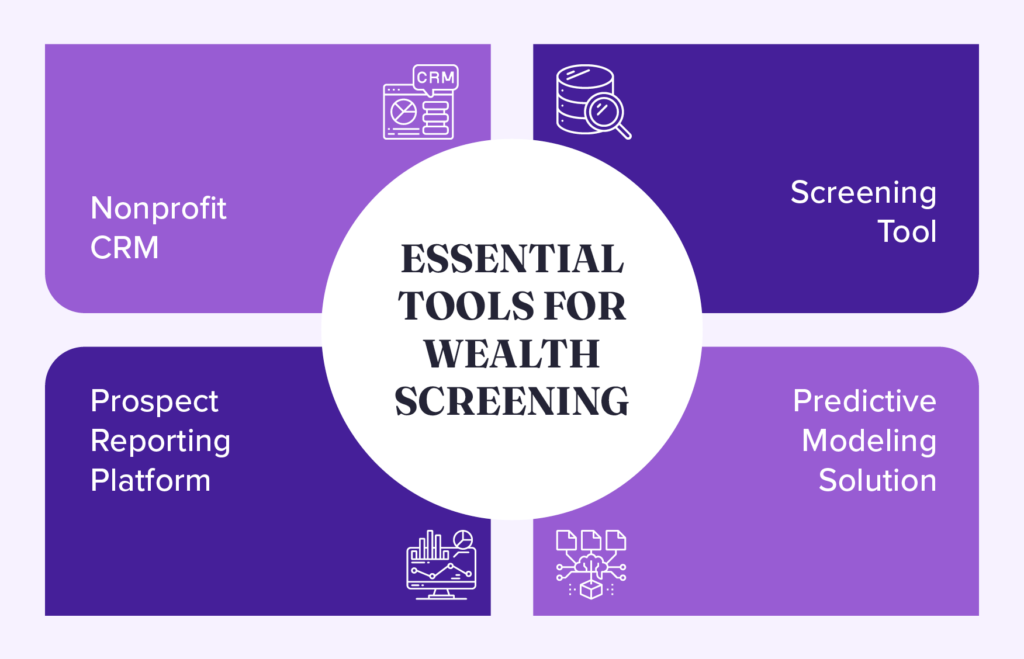
To conduct comprehensive screening that helps you see and understand all of the data points above, you’ll need the right tools in your tech stack. These include:
-
Nonprofit CRM
A robust internal database helps you find potential major donors among your existing supporters and tracks all of your wealth screening data in one place. Make sure your other screening tools integrate with your CRM to allow for seamless information sharing.
-
Screening Tool
Naturally, a tool that specializes in wealth screening (and, if possible, can also screen for philanthropic markers) is the most important platform for this process. These tools draw on trusted, public data sources to surface up-to-date insights on new and current donors.
-
Prospect Reporting Platform
While you can conduct wealth screenings with just the first two solutions, leveraging a platform that displays your results on easy-to-use dashboards and creates AI-powered summary reports for individual prospects simplifies post-screening data analysis and application.
-
Predictive Modeling Solution
Predictive modeling tools leverage AI to compare potential donors’ wealth and philanthropic indicators, prioritize prospect lists, and make outreach recommendations. Choose a tool that rates various giving likelihood factors (response rates, first gifts, retention, etc.) for best results.
DonorSearch by EverTrue offers all of these tools and more! Discover how our wealth and philanthropic screening tools, ProspectView Online 2 prospect report generator, DonorSearch Ai and Enhanced CORE predictive modeling solutions, and best-in-class CRM integrations can revolutionize your nonprofit’s fundraising.
Real-Life Wealth Screening Examples
If your nonprofit is ready to develop or revamp its wealth screening approach, you can start by drawing inspiration from the success that these real DonorSearch clients have achieved!

North Carolina State University
When NC State University started working with DonorSearch by EverTrue, it had hundreds of thousands of records in its CRM that its fundraising team was struggling to sift through in order to engage new donor demographics in high-impact giving. But once they screened their database using a custom segmentation template they created in collaboration with the DonorSearch team, NC State was able to double giving from parents of current students and raise an additional $1 million from parents of alumni!
Ronald McDonald House Charities of Chicagoland & Northwest Indiana
The RMHC-CNI development team adopted DonorSearch by EverTrue because they were hoping to replace their two disconnected screening platforms with an integrated solution that could help them collect, analyze, and act on donor insights. By leveraging DonorSearch’s seamless prospecting ecosystem and integrating it with their Blackbaud Raiser’s Edge NXT CRM, the team cut their screening software subscription cost in half while gaining access to richer analytics that led them to secure multiple seven-figure donations!
Life Teen International
Life Teen International turned to DonorSearch by EverTrue after its fundraising team realized that their existing resources and traditional screening methods weren’t keeping up with the organization’s growing needs. After revamping their approach with DonorSearch’s comprehensive, efficient solutions, Life Teen International began consistently exceeding its $5 million annual fundraising goal, and local branches have raised large amounts of money on short notice multiple times when equipped with accurate screening results.
Final Thoughts
Wealth screening provides essential insights into current and potential supporters that set your nonprofit up to secure high-impact gifts. Use the tips above to get started, and remember that a comprehensive prospecting platform like DonorSearch is your best bet for fully understanding your supporters’ ability and willingness to give.
For more information on wealth screening and related fundraising topics, check out these resources:
- Donor Acquisition: How to Attract High-Impact Supporters. Discover the next steps your nonprofit should take to acquire new donors after conducting wealth screenings.
- Donor Analytics: How to Make the Most of Donor Data. Dive deeper into the donor segmentation criteria that will help your organization make the most of screening.
- Major Gifts: How to Secure High-Impact Nonprofit Donations. Explore the full process of major gift fundraising and learn more about the role wealth screening plays in it.

Confidently approach major donor fundraising with comprehensive wealth and philanthropic screening and accurate, AI-powered donor insights.