Donor Acquisition: How to Attract High-Impact Supporters
If your nonprofit is planning to expand its operations and services, you’ll also need to grow your donor base. Identifying new donors not only provides the funding your organization needs to level up its mission-critical efforts but also the support you’ll need to thrive post-expansion. However, it’s essential to approach acquisition strategically to use your time and resources wisely.
In this guide, you’ll learn all you need to know for your nonprofit to succeed at donor acquisition, including:
Let’s get started with an overview of donor acquisition and how it relates to the bigger picture of supporters’ journeys with your organization.

Donor Acquisition: Frequently Asked Questions
What is donor acquisition?
Donor acquisition is the process of identifying and securing new donors for your nonprofit. The goal of donor acquisition is to secure more support for your mission, whether you’re trying to fund specific upcoming initiatives or make sure you’re bringing in enough revenue to cover day-to-day expenses.
How does acquisition fit into the donor lifecycle?
Donor acquisition is the first step in the nonprofit donor management lifecycle, which describes the step-by-step journey supporters take as they engage with your organization. Through a process known as moves management, your organization can strategically guide every donor from one step to the next to take them from an unengaged prospect to a loyal, impactful supporter.
The six major stages of the donor lifecycle are as follows:
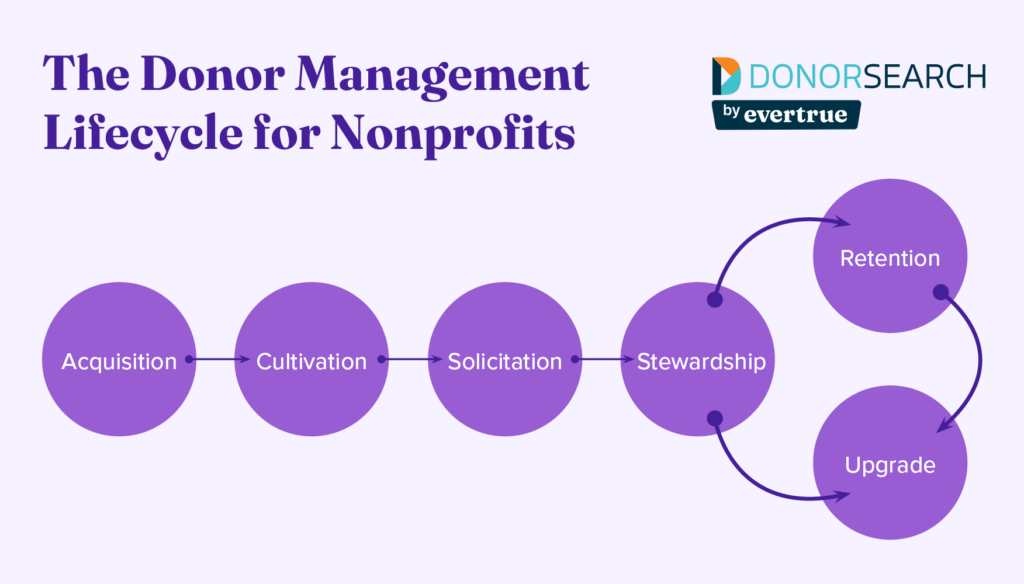
- Acquisition. As explained above, this stage involves identifying potential new donors and initially contacting them. Lower-level supporters are generally easy to acquire via mass marketing, while major donors require individualized outreach backed by prospect research (more on this later!).
- Cultivation. Once you’ve gotten a potential donor’s attention, you need to start building a relationship with them. Get to know their interests, values, and reasoning behind supporting your mission so you can offer opportunities to contribute that resonate with them.
- Solicitation. This stage is where you make your main donation request. For lower-level donors, you’ll often be able to do this very quickly. By contrast, you might need to offer several smaller engagement opportunities before soliciting a major gift to more naturally build up to that large ask.
- Stewardship. As soon as a donor responds positively to a solicitation, let them know that your nonprofit values their contribution. Your stewardship methods should match the size of each donor’s gift—a personalized thank-you email will do the trick for small contributions, while major donors warrant greater recognition, such as invitations to appreciation events or features in your organization’s annual report.
- Retention. After thanking a donor for their initial gift, establish a follow-up cadence to update them on your nonprofit’s happenings and encourage them to stay involved with your mission in various ways. Use what you’ve learned about the donor up to this point to tailor your retention efforts, such as by contacting them through their preferred communication channels and promoting opportunities that match their interests.
- Upgrade. When you get the sense that a supporter will stick with your organization for the long haul, you can start asking them for larger contributions that are still within their budget. For instance, you might try to convert a mid-level donor with a high giving capacity into a major donor or ask a one-time donor to join your recurring giving program. The stewardship, retention, and upgrade stages should be ongoing—once a donor increases their support, promptly thank them and continue following up with the eventual goal of another upgrade.
Acquisition sets the stage for your nonprofit’s entire relationship with every donor. By aligning your donor engagement goals with your organization’s overarching objectives, conducting thorough research, and targeting your outreach efforts, you’ll save your team time and effort throughout the rest of the process.
What are the benefits of donor acquisition?
When done effectively, donor acquisition allows your organization to:
- Expand its reach. Not only will you gain supporters overall, but you’ll also be able to target specific audiences who may be underrepresented in your current donor base or individuals who align with your mission but aren’t yet familiar with your organization.
- Achieve higher fundraising goals. Naturally, having a larger donor base and moving more individuals into your major giving pipeline allows you to bring in more total revenue, which is especially important for large-scale fundraising initiatives like capital campaigns.
- Create potential for organizational growth. Looking at the bigger picture, donor acquisition helps your nonprofit build the capacity it needs to scale up its programming and its community impact.
Although donor acquisition often requires significant time and resources, its short-term costs are generally worth its long-term advantages.
Should my nonprofit prioritize donor acquisition or retention?
It depends. Donor acquisition is commonly thought of as the opposite of donor retention, but they’re actually two sides of the same coin. After all, in order to retain a donor, you first need to acquire them!
To help you decide which activity to focus on in a given situation, here are some advantages of donor retention as compared to acquisition:
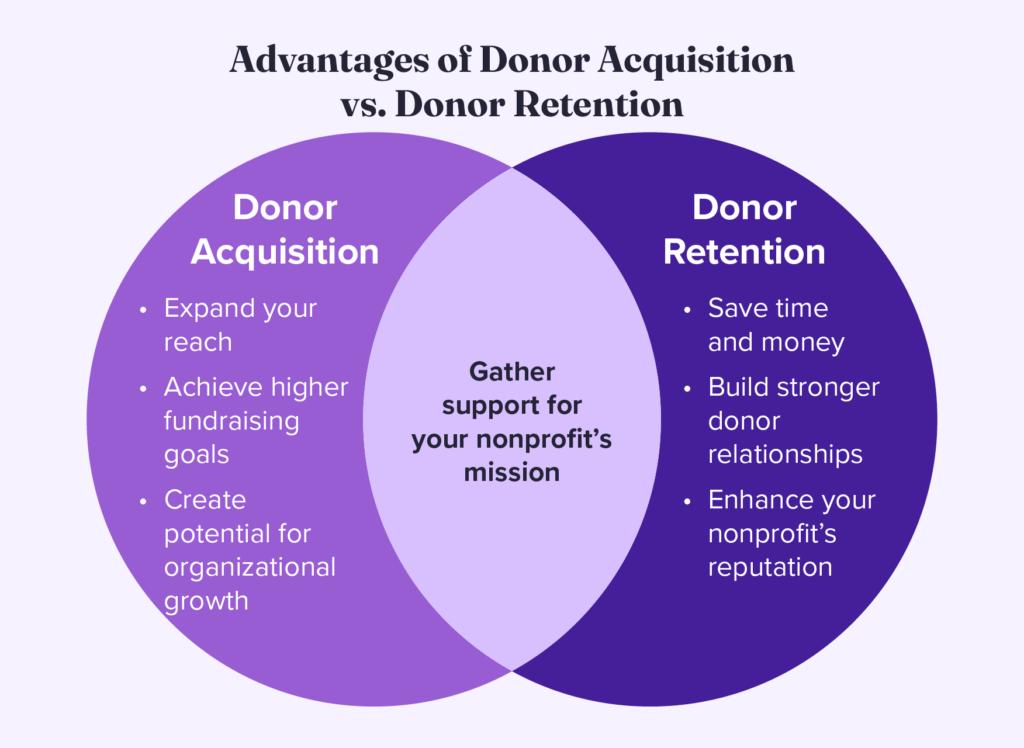
- Saving time and money. It’s estimated that acquiring one new donor costs five to 10 times more than retaining an existing donor. This number factors in the cost of research, outreach material creation, and staff time, among other considerations.
- Building stronger donor relationships. Retention provides your nonprofit with a stable support base and allows you to get to know each donor so you can tailor your communications to their preferences. For donors, having a relationship with your organization increases their passion for your mission, encouraging them to give more and participate in a variety of activities to make a stronger impact.
- Enhancing your nonprofit’s reputation. Loyal donors are also more likely to spread the word about your organization to their personal networks, and they can even help you form connections with new major donors or corporate sponsors. This advocacy allows you to grow your supporter base even more and position your nonprofit as a trustworthy organization that cares about its donors.
Generally speaking, if your organization is looking to grow, you should focus on donor acquisition to help you achieve those goals. But if you’re trying to maintain financial stability and build a stronger supporter community, prioritizing donor retention is your best bet.
Donor Acquisition Metrics to Track
Like with any priority at your nonprofit, you’ll need to choose and monitor metrics to know whether your nonprofit is succeeding at donor acquisition and determine how to adjust your strategy to be even more effective over time. Some data points you might pick include:
- Donor acquisition rate: What percentage of the individuals who gave to your nonprofit this year donated for the first time?
- Donor growth rate: How much did your donor base increase by this year, factoring in both donor acquisition and attrition (i.e., the number of supporters who stopped giving)?
- Conversion rate: How many individuals who received a fundraising ask made a contribution? (You can also break this metric down by marketing channel for lower-level donors and separately calculate your major gift solicitation success rate.)
- Donor acquisition cost: On average, how much does your nonprofit spend to acquire a new donor?
If you’re ready to figure out your nonprofit’s current donor acquisition cost and evaluate whether all of your spending on new donor outreach is worth it based on the contributions these supporters make, you can use the calculator below!
Strategies to Acquire New Donors
Now that you know why donor acquisition is important and when your nonprofit should focus on it, let’s walk through some actionable strategies you can use to attract new donors.
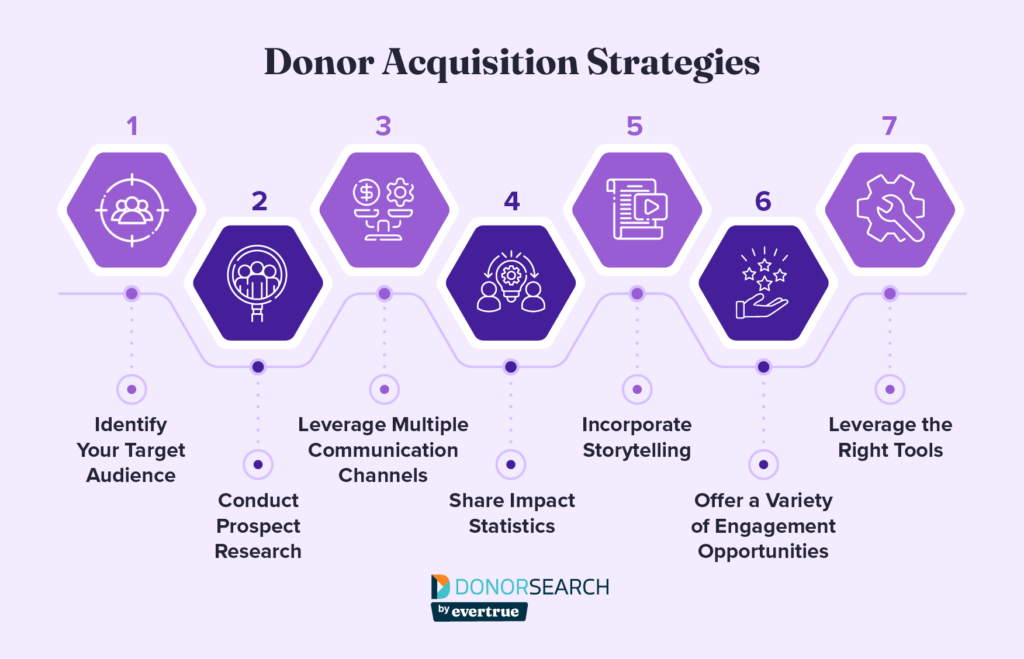
1. Identify Your Target Audience
Before you start reaching out to potential donors, you should first decide which potential donors will help your nonprofit reach its goals if you acquire them. This will save you time and money in the long run.
Segmentation—the process of grouping prospective supporters based on shared characteristics—can help you identify your target audience. Consider segmenting prospects based on the following traits:
- Demographics: Age, location, education, employment, family status, wealth
- Psychographics: Interests, hobbies, values, motivations for supporting your mission, preferred communication channels
- Charitable giving history with other nonprofits: Average donation amount, number of gifts, giving frequency
- Nonprofit involvement history: Interactions with marketing communications, event attendance, volunteering, advocacy, board service
If you’re focusing on major donor fundraising, you’ll need to narrow your outreach list further to the names of your top prospects (more on this in the next section). But if your goal is to acquire low-to-mid-level donors, choose your target audience segments and tailor your communications to each of them.
For example, let’s say you want to target millennials who live within 25 miles of your headquarters and would be willing to give $25-$100. While you’ll likely prioritize digital marketing to reach this demographic and frame your donation requests around the preferred range, you may need to segment further to provide the right information to each recipient. For instance, audience members who are brand-new to your nonprofit will need more details about your mission than past event attendees or volunteers who are familiar with your organization.
2. Conduct Prospect Research
Acquiring major donors requires even more targeted, one-to-one outreach than bringing in lower-level supporters. You can determine which donors to target in this segment by conducting prospect research—i.e., gathering data on individual supporters from inside and outside your organization that provides insight into their major giving potential.
During prospect research, look for the following data points on each donor, also known as markers or indicators:
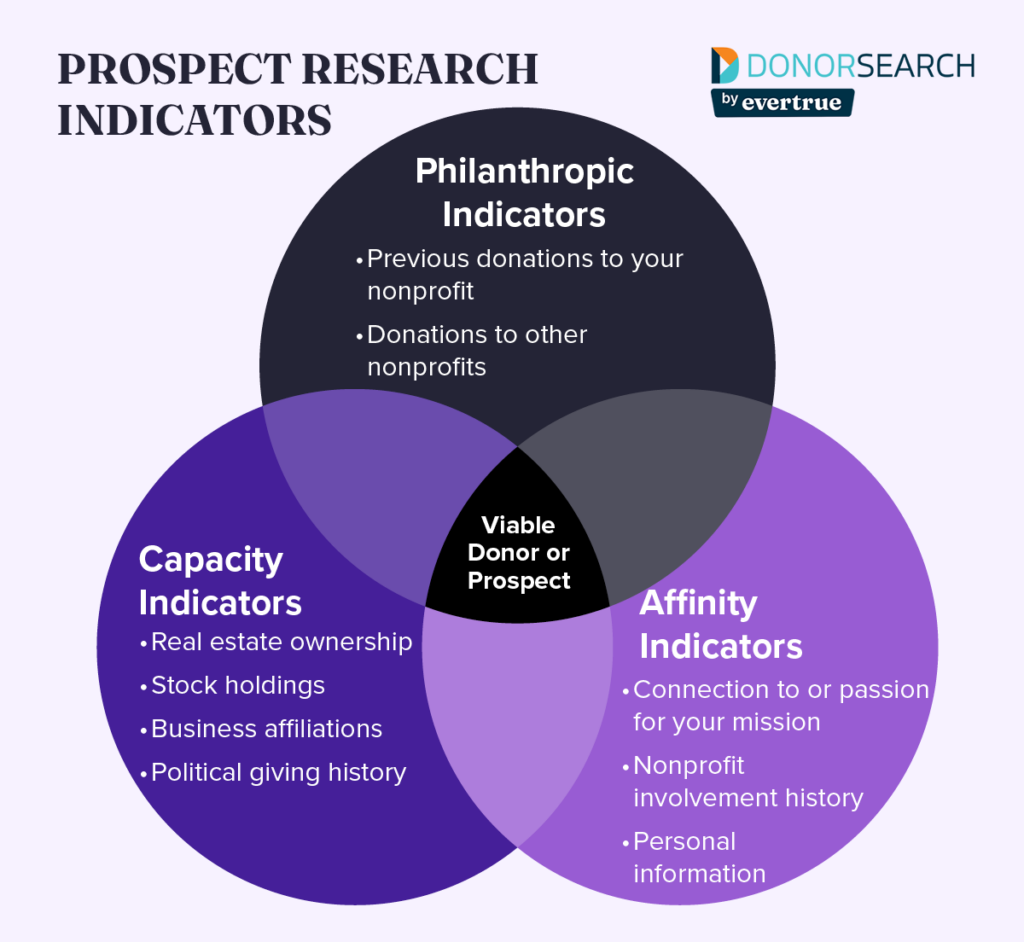
- Capacity (wealth) indicators: Real estate ownership, stock holdings, business affiliations, political giving
- Philanthropic indicators: Previous donations to your nonprofit or other similar organizations
- Affinity indicators: A connection to or passion for your mission, nonprofit involvement history (fundraising event attendance, volunteering, advocacy, board service, etc.), personal information (e.g., interests, values, and family ties)
When an individual meets all three criteria, you’ve found a viable prospect. Major donors need to have the ability to make a significant financial contribution to your nonprofit and the willingness to do so, as demonstrated by their charitable inclinations and interest in your mission.
3. Use Multiple Communication Channels
Donors at every level want to feel well informed about your nonprofit before they entrust you with their financial resources. Provide them with all of the information they need by implementing a multi-channel marketing strategy that includes the following types of communications:
- A well-designed nonprofit website. Your website is the main hub of information for current and prospective supporters, and your online donation form is an essential tool for collecting small and mid-level gifts. Ensure your site is easy to navigate, accessible, and optimized for mobile so every donor can gain value from it.
- Search ads. Google offers an Ad Grant program in which eligible nonprofits can receive $10,000 worth of free advertising per month. These ads are meant to drive more traffic to your website and donation form by allowing them to appear higher up in Google search results. You can even target your Google Ads by location if you want to attract donors in a specific area.
- Social media. The social media platforms your nonprofit prioritizes will depend on what audiences you want to reach. For example, research shows that individuals in their 40s are most likely to use Facebook and LinkedIn, while potential supporters in their 20s favor Instagram and TikTok.
- Email marketing. Email is one of the most versatile communication methods because it’s both personal and useful for mass marketing. Common types of nonprofit emails include recurring newsletters, campaigns promoting specific fundraising initiatives, and individual thank-you emails for donations and other involvement.
- Text messaging. Texts have similar advantages to email in terms of personalization and automation, plus they allow busy donors to give from anywhere. Many SMS providers limit marketing texts to 160 characters, so make your messages concise and include links to relevant mobile-optimized web pages if donors need more information.
- Print communications. Although many organizations focus on digital marketing, print materials like flyers and direct mail are still helpful for reaching certain audiences and supplementing your online efforts. For example, you could hang flyers promoting a fundraising campaign around town and include a QR code to your online donation form or follow an automated thank-you email with a handwritten note that shows you care.
- One-on-one conversations. This method is especially important for attracting major donors because it lets you get to know your prospects and shows that your nonprofit values their individual support. An introductory face-to-face meeting is preferable, but phone calls and video conferences may do the trick for prospects who live far away.
Track engagement data for all of these channels to see which aspects of your marketing strategy are working well and where you could make changes to expand your reach. Additionally, during initial meetings with major donor prospects, note their preferred follow-up methods so you can keep them engaged through the channels they’re most likely to respond to.
4. Share Impact Statistics
Concrete data can make your donor acquisition communications more impactful by providing social proof of why your audience should support your nonprofit. Consider sharing statistics such as:
- The number of individuals your organization helped in a given time period
- The amount of money raised for your mission during a previous campaign or fiscal year
- The types of awards or recognitions your nonprofit has received from external sources
Strategically choose which impact statistics to share based on the initiative you want audience members to support. For example, mentioning how many people your nonprofit helped last year could persuade new supporters to contribute to your annual fund. Or, reporting your fundraising total from last GivingTuesday may persuade donors to help break that record during your upcoming GivingTuesday campaign.
5. Incorporate Storytelling
While social proof demonstrates your nonprofit’s credibility, telling true stories about your organization’s work in your communications appeals to your audience’s emotions to make your asks even more compelling. Here are some tips for effective nonprofit storytelling:
- Center each story on one main character. This could be a loyal supporter (which is more relatable for potential donors) or one of your organization’s beneficiaries (which pulls more at your audience’s heartstrings). Either way, make sure to get the individual’s consent before sharing their name, photo, and experiences for marketing purposes.
- Demonstrate your organization’s impact. Just like the stories told in novels and movies, your story should have a beginning, middle, and end. Explain a problem that your nonprofit saw in the community and describe the steps you took to solve it.
- Tie the story into your call to action. Once you wrap up your story, emphasize that its happy ending was only possible because of your supporters’ generosity. This is also a great place to connect some impact statistics to ground the story in reality before making your fundraising ask.
To see this strategy in action, let’s look at a potential story an animal shelter might use:
Bennett, a four-year-old gray tabby cat, came to our shelter after his previous owner could no longer care for him. During his stay with us, our medical team brought him up-to-date on his vaccinations and treated his advanced dental disease to improve his quality of life. Our amazing shelter staff and volunteers also socialized with Bennett every day so he could go to his forever home happy and healthy.
Bennett was just one of 200 cats adopted from our shelter last year, and all of them received the same excellent medical and social care thanks to the support of our generous donors. To help more cats in need like Bennett, click here to donate online!
This story pulls at the reader’s heartstrings by focusing on one of the shelter’s beneficiaries (Bennett the cat). It sets up the conflict of Bennett losing his home, describes the specific medical and social care he received to demonstrate the shelter’s impact, and ends happily with his adoption. The second paragraph ties the story to a concrete statistic and leads into the call to action for audiences to donate so even more rescue animals can have that happy ending.
6. Offer a Variety of Engagement Opportunities
While many of your acquisition-related communications will focus on fundraising, you shouldn’t request donations in every single one. Some new donors will want to get a feel for your nonprofit’s work in other ways before they commit to donate, especially if their main contribution will be a major gift.
Mix up your fundraising asks with messages promoting other types of opportunities, such as:
- Volunteering
- Attending fundraising events
- Engaging with your organization on a new communication channel (for instance, following you on a certain social media platform or signing up for text notifications)
- Joining a committee to help with a project
For major donor prospects in particular, tailor your other involvement requests to what you know about each individual. For example, if a prospect says they enjoy running during their initial one-on-one meeting, send them a personalized invitation to register early for your upcoming 5K fundraising event. Or, if they have younger children or grandchildren, let them know about family-friendly volunteer opportunities they could attend together.
7. Leverage the Right Tools
Donor acquisition becomes significantly easier when your team has modern software on its side. Make sure your tech stack includes the following solutions before you put your plan into action:
- A robust donor database or constituent relationship management (CRM) system to segment prospective donors and track your interactions with them
- A prospect research platform to find accurate, thorough information on potential major donors’ wealth and philanthropic histories
- Predictive modeling tools to sort through your prospecting data and make recommendations to help you prioritize your outreach efforts
If you’re in the market for a fundraising platform that combines all of these tools into a unified solution, look no further than DonorSearch by EverTrue! In addition to a prospect research database that contains more than a billion data points and is updated weekly, DonorSearch offers two predictive modeling solutions (DonorSearch Ai and Enhanced CORE) to provide deeper insights into your donors. Plus, DonorSearch integrates with over 40 popular nonprofit CRMs and fundraising tools for seamless data transfer.
More than 15,000 nonprofits of all sizes and missions trust DonorSearch’s prospect research tools to help them accomplish their donor acquisition goals. But don’t just take our word for it—check out this video to see how the Northwest Osteopathic Foundation used DonorSearch to shift from a membership-based strategy to a fundraising-based approach and identify high-impact donors along the way!
Final Thoughts
Donor acquisition is essential for your nonprofit to grow and thrive. Use the strategies above to get started, but keep in mind that every organization is unique, so you’ll need to adapt the tips based on your organization’s needs and capabilities. When done well, your donor acquisition efforts will set the stage for effective cultivation, long-term retention, and increased support for your mission.
For more information on donor acquisition, check out these resources:
- How to Create a Donor Profile: Ultimate Nonprofit Guide. Discover how to build out an effective CRM profile for each of your newly acquired donors.
- Major Gifts: How to Secure High-Impact Nonprofit Donations. Dive deeper into the unique process of acquiring and cultivating major donors.
- Donor Analytics: How to Make the Most of Donor Data. Explore strategies for using existing donor data to attract new supporters to your organization.